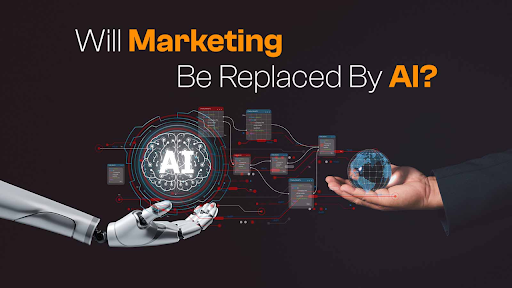
As organizations accelerate toward automation, efficiency, and data-driven operations, one question keeps resurfacing among marketers: Is AI going to replace marketing teams?
This question comes from both curiosity and fear. AI can automate campaigns, generate content, analyze data, predict customer behavior, personalize messages at scale, and even design creative assets. With such capabilities, it’s easy to imagine a future where brands no longer rely on human marketers. However, the future is not a battle of “humans versus AI.” Marketing is slowly shaping into a partnership in which AI elevates human creativity, strategy, empathy, and decision-making.
This article takes a closer look at how AI is changing marketing, what it can and cannot replace, and what the future looks like for marketing professionals beyond 2025.
The Current AI Impact on Modern Marketing
Marketing in 2025 looks completely different from the landscape even a few years ago. Today, AI is tightly integrated into content creation, search engine optimization, audience insights, personalization engines, and real-time customer communication. Visual intelligence is also becoming a core part of modern marketing AI. Clip AI models connect image understanding to natural language, enabling marketers to analyze creative assets at scale, predict which visuals resonate with specific audience segments, and automate the tagging of large content libraries. For performance marketing teams managing hundreds of ad creatives across multiple campaigns, this kind of visual AI cuts down manual review time considerably while improving the relevance of asset selection. Marketers rely on AI-powered content tools to draft blogs and ad copies, while SEO systems analyze search patterns and optimize keywords automatically. Visual content creation has also been revolutionized, with AI photo editor tools enabling marketers to enhance images, remove backgrounds, and generate branded visuals in seconds. Advanced platforms interpret enormous data sets, identify micro-audiences, and predict purchase behaviors with unmatched accuracy.
Customer service has also evolved into a 24/7 automated experience where chatbots engage, respond, and assist users without waiting for human operators. In short, AI has not just improved marketing processes, it has redefined them.
The question is not whether AI is powerful, but whether its growing role means marketers are becoming irrelevant.
What AI Can Do And Where It Still Falls Short
The strength of AI lies in repetitive, data-intensive, technically structured tasks. It can schedule social posts, send automated emails, generate AI videos, optimize ad targeting, generate analytics reports, personalize recommendations, and predict customer actions. AI tools are designed to absorb unlimited data, recognize patterns, and respond with remarkable efficiency.
However, AI is not capable of fully understanding emotions, cultural contexts, or subtle brand nuances. It struggles to grasp emotional storytelling, brand identity, and real human relationships, the core components of marketing that rely on empathy and creativity. AI cannot invent cultural moments or create original ideas that are not based on historical patterns. It simply follows the data it learns from.
Because of this, AI remains a powerful assistant, but it’s far from being a complete replacement for content marketing expertise.
Will AI Actually Replace Marketing Teams?
The most realistic future is a hybrid world where AI and marketers collaborate closely. According to multiple industry research reports, AI may automate nearly half of routine marketing work, but full replacement remains highly unlikely. While businesses will consider the cost of AI implementation, the technology will take over operational and analytical roles, allowing human marketers to continue leading strategy, emotional engagement, brand positioning, and storytelling. Future marketing teams will look very different. Traditional job titles may slowly disappear, and new AI-aligned roles will take their place. Content writers, for example, may evolve into content strategists and prompt engineers, while data analysts expand into AI-focused marketing data scientists. Social media managers may shift toward community engagement roles that blend AI automation with human relationship-building.
Rather than eliminating marketers, AI is reshaping what marketers do and elevating the human part of the profession.
The Future Skills Every Marketer Will Need
Marketing professionals of the future will increasingly combine creativity with technical fluency. Understanding how AI systems work and learning to guide them effectively will become as essential as writing or campaign planning. Prompt engineering, strategic thinking, and creative storytelling will become central marketing skills.
One practical consequence of AI adoption in marketing is a shift toward smaller, more specialized tool stacks. Rather than one monolithic suite, modern teams are assembling best-in-class tools for each function and connecting them through automation layers. The challenge for most teams is cost. Subscribing to five or six specialized SaaS products simultaneously adds up fast, especially before you have proven ROI to justify the spend. Platforms that aggregate deals and promo codes on marketing software are becoming a useful resource for startups and scale-ups trying to build a competitive stack without blowing their budget in the process.
Human creativity will matter more, not less. In a world where everyone has access to AI-generated content, authenticity, emotion, and original brand experiences will be the key to standing out. Marketers will also play critical roles in ethical decision-making, ensuring AI-driven marketing respects privacy, avoids bias, and maintains trust.
Collaboration will expand beyond marketing departments. Professionals will work more closely with data scientists, product innovators, and technology teams, creating a more interconnected marketing ecosystem.
The Rise of the “Marketing Engineer”
One exciting development is the emergence of hybrid professionals who blend marketing expertise with data, automation, and AI optimization. These “Marketing Engineers” design AI-based personalization systems, visualize strategic roadmaps, and translate brand goals into machine-readable strategies, automate customer journeys, translate brand goals into machine-readable strategies, and integrate AI into every stage of the funnel.
They bridge the gap between marketing creativity and technical execution, becoming essential figures in the modern marketing organization.
Risks and Ethical Challenges Ahead
AI adoption also raises several concerns. Overusing AI for content creation can lead to bland, robotic messaging that lacks emotional depth. Personalization algorithms may cross privacy boundaries if not monitored responsibly. Bias in machine learning models can unintentionally exclude or misrepresent certain groups.
The fear of job loss remains real for many marketing professionals. While new AI-related roles will emerge, older, manual roles may gradually disappear, creating transition challenges for organizations and individuals. Governments are already working on stricter compliance frameworks, and marketers will need to follow them carefully to avoid legal and ethical risks.
As AI systems become more embedded in marketing operations, ingesting CRM data, accessing ad platforms via API, and automating outreach at scale, they also expand the attack surface of the organization. A compromised AI marketing tool can expose customer data, drain campaign budgets, or silently distort audience targeting in ways that are hard to catch. Security and marketing ops teams are increasingly working together on this, with more organizations now incorporating ai pentesting tools into their vendor assessment processes. Identifying vulnerabilities in AI-integrated workflows before they go live is becoming a standard part of responsible marketing infrastructure management.
Final Thoughts
So, can AI replace marketing teams? The answer is no, yet the future of marketing will undeniably evolve in a direction where humans and AI complement each other. AI will continue handling repetitive, analytical, and operational tasks, while humans focus on creativity, emotional intelligence, strategy, and ethical decision-making.
Marketers who fear AI may feel threatened, but those who embrace it will discover new opportunities and career paths that didn’t exist before. Success will belong to those who balance innovation with authenticity, and who are willing to evolve, learn, and collaborate with intelligent systems rather than compete against them. The future of marketing is not about choosing between humans and AI, it is about building a powerful partnership between them.