

The headcount decision gets made in a boardroom in an afternoon. The five-year lease signed two years earlier takes months to unwind, if it unwinds at all. You end up paying for forty desks while twelve people pack their things, and the empty floor becomes a daily reminder of a decision that already hurt enough the first time.
That gap between how fast a business needs to move and how slowly commercial property lets it move has become one of the sharpest risks a startup carries. Tech layoffs alone have hit 267 events and close to 186,000 workers so far this year, averaging almost a thousand job losses a day, and AI-driven restructuring now sits behind a majority of the cuts. For recruiters and people teams watching this from the inside, the pattern is familiar: hiring surges, market conditions shift, and the business that scaled its office along with its headcount now owns a liability it can't shed quickly. The businesses handling this best aren't the ones avoiding growth. They're the ones who never signed away their flexibility in the first place.
The Lease Is the Risk, Not the Team
A traditional commercial lease locks a company into square footage for three, five, sometimes ten years, regardless of what happens to revenue, funding, or headcount in year two. That structure made sense when growth was linear and predictable. It makes far less sense now. Dilapidation costs alone can run tens of thousands of pounds when a company finally exits a lease, on top of the fit-out spend that stays with the landlord the moment you walk out the door. None of that capital comes back. It just sits on the balance sheet as dead weight while the finance team tries to explain to the board why cash reserves look thinner than they should.
Shared and hybrid office models flip that structure. A business pays for the desks it's using this month, not the desks it hoped to fill by next year. When a downturn forces a reduction in force, the real estate cost scales down alongside the headcount instead of sitting there as a fixed obligation working against the recovery plan. That single change removes one of the biggest hidden liabilities a growing company carries, and it's exactly the kind of liability that turns a difficult layoff into a genuinely damaging one.
Why This Matters Beyond the Balance Sheet
Recruiters know that a company's real estate decisions ripple into employer brand faster than most founders expect. A half-empty office post-layoff sends a signal to the remaining team that's hard to undo with an all-hands meeting. A shared workspace, by contrast, keeps the energy of the room consistent even as one company's headcount shifts, because the space itself is full of other businesses, other teams, other conversations happening around you. The people who stayed through the layoff walk into a space that still feels alive, not one that broadcasts the exit of their former colleagues in empty chairs.
There's a hiring angle too. When the market turns and the business is ready to grow again, a flexible workspace lets a people team scale the physical footprint at the same pace as the offer letters go out, rather than waiting on a broker to find, negotiate, and fit out new space over several months. That speed matters when you're competing for talent against companies that can onboard someone into a real desk in their first week.
Mindspace: The Case for Going Global
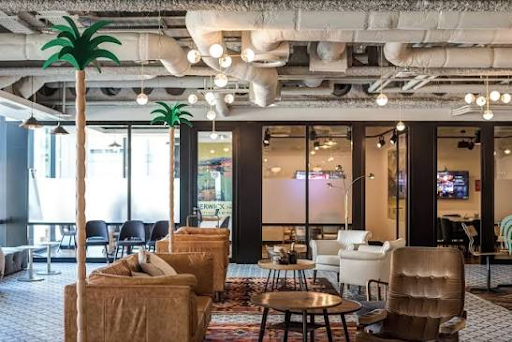
Among the shared workspace operators built for this kind of resilience, Mindspace stands out because of how far its flexibility actually stretches. The company operates in more than 20 cities across the US, UK, Germany, Israel, Poland, the Netherlands, and Romania, which means a business isn't just renting a desk. It's buying the option to move that desk anywhere in the network as headcount, funding, or strategy shifts. A team based in London can resize into a smaller suite after a layoff, then a year later open a second hub in Berlin or New York without ever leaving the Mindspace ecosystem or negotiating a new provider from scratch.
The contract structure backs this up in practice. Mindspace's team suites, built for groups of ten to a hundred people, start on six-month agreements with the option to extend, resize, or relocate to a different city entirely. That's a materially different risk profile than a five-year lease with a fixed floor plan. A business that needs to shrink from sixty desks to twenty-five after a hard quarter can do it inside the same agreement structure, and a business that needs to jump from one city to three as it expands internationally can do that too, without the churn of packing up an entire operation each time.
The ROI case holds up beyond flexibility alone. Ninety-three percent of Mindspace members globally report that working from the space benefits their business, a number that reflects more than a nice interior. It reflects a model where furniture, utilities, cleaning, enterprise-grade Wi-Fi, IT support, and reception all sit under one predictable monthly invoice, removing the administrative overhead that would otherwise fall on a stretched HR or operations team mid-restructuring. For a people function trying to protect morale, budget, and momentum all at once during a difficult stretch, that predictability is worth more than most line items on the spreadsheet.
The Takeaway for HR and People Teams
Layoffs will keep happening as long as funding cycles, AI adoption, and market conditions keep shifting the ground under fast-growing companies. What separates a controlled reduction from a chaotic one often comes down to decisions made well before the layoff itself, and the office lease is one of the biggest of those decisions. A hybrid, shared workspace model turns a fixed real estate liability into a variable one that moves with the business rather than against it. Mindspace's global footprint and flexible contract terms make that model concrete rather than theoretical, giving people teams one less unpredictable cost to manage the next time headcount planning gets hard. Build the flexibility in now, and the next difficult quarter costs the business a lot less than it otherwise would.


