

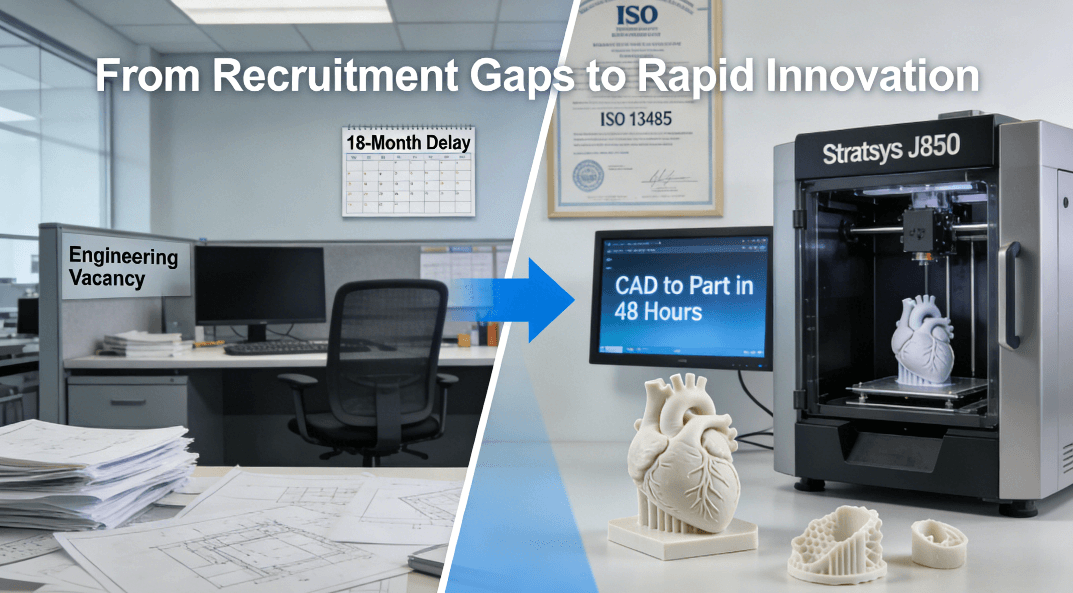
The medical device industry is navigating a perfect storm of innovation pressure and a critical talent shortage. Recruitment gaps in specialized engineering roles are causing significant delays, with traditional development cycles averaging 18-24 months. Statistics reveal that 60% of medical device companies miss crucial innovation windows due to hiring delays, leading to escalated costs and lost competitive advantage. The root cause lies in a reliance on lengthy, manual processes that demand scarce, high-skilled workers for prototyping and validation.
This article explores a strategic solution: integrating advanced rapid prototyping technologies and compliant workflows to streamline development. By doing so, companies can reduce their dependency on hard-to-find talent, accelerate iteration, and significantly reduce time-to-market, transforming their approach to innovation hiring.
H2: What Recruitment Trends Are Reshaping Medical Device Manufacturing in 2026?
The landscape of talent acquisition is evolving rapidly, forcing medical device manufacturers to adapt their hiring strategies to secure a competitive edge. Understanding these shifts is the first step in building a resilient workforce.
H3: 1. The Rise of Remote Work and Digital Nomadism
Despite soaring demand from professionals, data indicates that only 5% of new UK jobs are remote, creating a mismatch between candidate expectations and traditional manufacturing roles. For medical device companies, this presents both a challenge and an opportunity. Embracing flexible or hybrid models for design, simulation, and project management roles can tap into a global talent pool, mitigating local skill shortages. However, this requires robust digital infrastructure and a shift in management culture to maintain collaboration and compliance in a distributed team environment.
H3: 2. The Acute Digital Skills Gap
The industry's digital transformation has outpaced the availability of talent proficient in advanced CAD/CAM software, AI-driven design analysis, and digital twin technologies. This gap is not just about technical know-how; it's about applying these skills within the strict regulatory frameworks of medical device development. Companies are now competing with tech giants for the same data and software talent, necessitating a reevaluation of value propositions, continuous upskilling programs, and strategic partnerships to bridge this critical divide.
H3: 3. The Integration of HR Technology and Data-Driven Hiring
Forward-thinking HR departments are leveraging AI-powered recruitment tools to streamline candidate sourcing and screening. These platforms can efficiently identify candidates with specific experience in, for instance, ISO 13485 compliant development or bio-compatible material science. By using data analytics, companies can move beyond traditional resumes to assess a candidate's potential for innovation and problem-solving, which are crucial for navigating the complexities of device development and accelerating the hiring process for specialized roles.
H2: How Can Rapid Prototyping Bridge the Engineering Skills Gap and Reduce Time-to-Market?
Rapid prototyping serves as a force multiplier, enabling existing teams to achieve more with less and reducing the project-stalling impact of unfilled vacancies. It directly addresses the core inefficiencies of traditional development.
H3: 1. Accelerating Design Iteration and Validation Cycles
Traditional prototyping methods are slow and require highly skilled machinists or engineers for each change. Advanced rapid prototyping technologies, such as multi-jet fusion and stereolithography, allow for the digital fabrication of complex parts in hours, not weeks. This empowers junior engineers or designers to execute multiple iterative design cycles within a single day, facilitating rapid learning and reducing the bottleneck typically created by a shortage of senior prototyping specialists. This dramatic compression of the feedback loop is key to reducing medical device time-to-market.
H3: 2. Democratizing Prototyping Through Digital Workflows
The integration of digital thread methodologies creates a seamless flow from design to physical part. As highlighted by the National Institute of Standards and Technology (NIST) in their smart manufacturing research, this integration is vital for agile production processes. When a design is finalized, the digital file can be sent directly to an in-house 3D printer or a trusted manufacturing partner with minimal manual intervention. This reduces dependency on highly specialized CNC programmers for early-stage prototypes, allowing companies to leverage a broader range of engineering talent for innovation rather than manual execution.
H3: 3. Enhancing Collaboration and Reducing Rework
Physical prototypes facilitate clearer communication between design, engineering, and regulatory teams. By using high-fidelity functional prototypes early in the process, potential design flaws or compliance issues can be identified and addressed before committing to expensive tooling. This proactive approach, often supported by comprehensive rapid prototyping for medical devices, minimizes costly late-stage changes that typically require scarce senior experts to resolve, effectively de-risking the project timeline against recruitment challenges.
H2: What Are the FDA Submission Considerations for Prototypes in Accelerated Innovation Hiring?
Prototypes are not just for internal validation; they play a critical role in the regulatory pathway. A strategic approach to prototyping can streamline submissions and build a compelling case for safety and efficacy.
➔ Establishing Design Control and Traceability Early: The FDA requires rigorous design control documentation throughout the development process. Using prototypes created within a structured Quality Management System (QMS) lays the groundwork for a successful submission. Each prototype iteration should be treated as a data point, with detailed records of its design intent, manufacturing process, and test results. This demonstrates to regulators a systematic and meticulous approach to product development, which is easier to manage with a streamlined prototyping process that generates consistent, traceable data.
➔ The Role of Prototypes in Pre-Submission Meetings: A well-prepared prototype for FDA submission discussions can be invaluable. Presenting a functional model during a pre-submission meeting helps clarify the device's design, intended use, and testing strategy. This tangible evidence facilitates more productive dialogue with FDA reviewers, potentially identifying potential questions or concerns early. This proactive engagement can shorten the review cycle and prevent submission deficiencies later, making the regulatory team's work more efficient and less dependent on last-minute heroics from a single regulatory affairs expert.
➔ Aligning Prototyping Practices with ISO 13485 Standards: Adherence to ISO 13485:2016 is a cornerstone of medical device quality. This standard emphasizes risk management and process validation. Prototyping activities must be conducted under similar controls. This includes validating the rapid prototyping process itself for consistency and ensuring materials used are suitably documented. By integrating these practices early, companies build a culture of quality that extends to their hiring, as they can seek talent familiar with these compliant workflows, thereby strengthening their overall regulatory compliance strategy.
H2: How Does Low-Volume Manufacturing Enhance Cost Efficiency and Recruitment Flexibility?
The ability to produce small batches cost-effectively is a game-changer, allowing companies to validate markets and technologies without the burden of large-scale capital and staffing investments.
H3: 1. Enabling Agile Clinical Trial and Pilot Production
Before committing to full-scale production, devices must often be manufactured for clinical trials or limited market releases. Traditional high-volume manufacturing lines are economically unviable for this. Low-volume manufacturing techniques, such as rapid tooling and on-demand CNC machining, allow for the production of dozens to hundreds of units efficiently. This eliminates the need to hire and train a large production team upfront, allowing companies to validate product efficacy and market demand with minimal financial risk and a lean, focused team.
H3: 2. Reducing Overhead and Optimizing Staffing Budgets
Establishing a full-scale production facility requires massive capital expenditure and a corresponding large workforce. By partnering with experts in low volume medical device manufacturing for initial production runs, companies can convert fixed labor costs into variable operational expenses. This model provides significant financial flexibility, freeing up capital that can be redirected towards targeted hiring for core R&D and innovation roles rather than general production staff, thereby optimizing the recruitment budget for maximum strategic impact.
H3: 3. Facilitating Scalable and Phased Hiring Strategies
A low-volume approach allows for a phased product launch and a corresponding phased hiring strategy. A company can start with a compact, multi-skilled core team to manage the initial launch and then scale its workforce strategically based on clinical success and market reception. This mitigates the recruitment risks associated with over-hiring before revenue is confirmed and supports a more sustainable, scalable business model that can adapt quickly to real-world feedback and results.
H2: What Role Does Medical Grade 3D Printing Play in Sustainable Innovation Hiring?
Sustainability is increasingly important to both consumers and potential employees. Adopting green technologies can enhance a company's brand and make it more attractive to top talent.
H3: 1. Minimizing Material Waste and Environmental Impact
Traditional subtractive manufacturing can generate significant material waste. Medical grade 3D printing, being an additive process, builds parts layer by layer, using only the necessary material. This aligns with the U.S. Environmental Protection Agency's (EPA) focus on sustainable manufacturing practices and pollution prevention. By reducing waste, companies not only lower their environmental footprint and material costs but also project a forward-thinking, responsible image that is highly attractive to a new generation of engineers who prioritize environmental, social, and governance (ESG) principles.
H3: 2. Enabling Lightweighting and Complex Geometries for Efficiency
Additive manufacturing allows for the creation of optimized, lightweight structures that are impossible to achieve with traditional methods. Lighter devices can reduce shipping emissions and material usage over the product lifecycle. This capability to drive sustainable innovation through design is a powerful recruitment tool. It allows companies to showcase projects that are not only clinically effective but also environmentally conscious, appealing to candidates motivated by working on cutting-edge, sustainable solutions for healthcare challenges.
H3: 3. Building an ESG-Centric Employer Brand
A visible commitment to sustainable technologies like medical grade 3D printing helps build a strong employer brand. Companies that lead in this area are seen as innovators, making them magnets for talent seeking meaningful work. This strategic positioning helps in attracting top-tier candidates who are driven by more than just a paycheck; they want to contribute to a company that is actively reducing its environmental impact and advancing medical science responsibly, turning a hiring strategy into a powerful component of innovation hiring.
H2: How Can Companies Implement Cost-Effective Prototyping Strategies to Mitigate Recruitment Risks?
A strategic approach to prototyping is not merely a technical decision; it is a core business strategy that directly de-risks talent acquisition and project execution.
H3: 1. Developing a Phased Prototyping Roadmap
To maximize cost efficiency, companies should adopt a phased approach to prototyping. Initial concepts can be produced using low-fidelity, inexpensive methods to test form and basic function. As the design matures, prototypes can advance to high-fidelity functional models using materials closer to the final product. This roadmap ensures that financial resources are allocated wisely, preventing overspending on early-stage models and allowing the budget to accommodate the specialized talent needed for later, more complex stages of development, thereby mitigating financial and recruitment risks.
H3: 2. Leveraging Strategic Manufacturing Partnerships
Rather than investing heavily in internal capabilities that require specialized hires, companies can partner with established manufacturers. The right partner brings not only equipment but also deep expertise in design for manufacturability (DFM) and regulatory compliance. This provides immediate access to a "virtual team" of experts, effectively bridging critical skills gaps without the lead time and cost of permanent hiring. This model offers unparalleled flexibility, allowing internal teams to focus on core innovation while leveraging external excellence for execution.
H3: 3. Integrating Digital Tools for Continuous Improvement
Implementing a closed-loop digital system where data from prototype testing is fed directly back into the CAD model creates a continuous improvement cycle. This data-driven approach, supported by predictive analytics, helps optimize designs before they are physically built, reducing the number of prototyping iterations required. This efficiency makes the entire R&D team more productive, reducing the pressure to hire excessively to meet deadlines and ensuring that the company's path to a cost-effective medical prototype is both swift and reliable.
H2: Conclusion
The recruitment challenges in the medical device sector are formidable, but they can be overcome by rethinking the product development lifecycle. By strategically integrating rapid prototyping and low-volume manufacturing, companies can decouple innovation speed from hiring bottlenecks. This approach enhances operational agility, reduces time-to-market, and allows organizations to focus their hiring efforts on strategic innovation roles. Embracing these technologies is no longer just a technical advantage; it is a essential strategy for building a resilient, future-proof manufacturing operation.
H2: FAQs
Q1: What is the average time savings with medical device rapid prototyping?
A: Companies can achieve reductions in development cycles by up to 40%, compressing timelines from months to weeks. This is achieved by enabling rapid design iterations and facilitating early feedback, which is crucial for accelerating regulatory submissions and overall time-to-market.
Q2: How does ISO 13485 impact prototype quality?
A: ISO 13485 provides a rigorous framework for quality management, ensuring that prototyping processes are controlled, documented, and traceable. This is critical for building a compelling FDA submission as it demonstrates a systematic approach to managing risk and quality from the earliest stages, reducing delays caused by non-compliance.
Q3: Can low-volume manufacturing support clinical trials?
A: Absolutely. Low-volume production is ideal for creating the batches needed for clinical trials and pilot launches. It provides the flexibility to produce small quantities cost-effectively, allowing companies to gather vital clinical data and user feedback without the significant investment in full-scale production infrastructure and staffing.
Q4: What materials are used in medical grade 3D printing?
A: Common materials include biocompatible resins (e.g., for surgical guides) and medical-grade metals like titanium and cobalt-chrome alloys (e.g., for implants). These materials are engineered to meet stringent international standards for safety and performance, such as USP Class VI and ISO 10993, ensuring they are suitable for their intended medical applications.
Q5: How can companies start with cost-effective prototyping?
A: The most effective first step is to engage with an experienced manufacturing partner for a Design for Manufacturability (DFM) analysis. Many partners offer a rapid prototyping instant quote based on your CAD files, providing immediate insights into cost, timeline, and material options, allowing for informed, low-risk decisions early in the design process.