
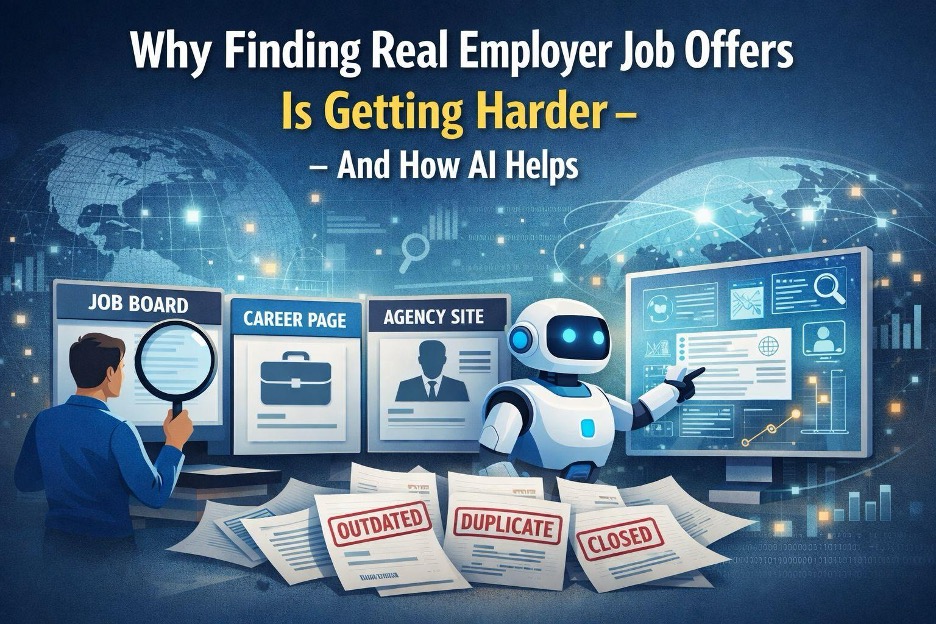
In many cases, employers no longer rely solely on traditional job boards. Vacancies are now published directly on company career pages, regional websites, applicant tracking systems, and country-specific portals. As a result, job listings are spread across hundreds of sources, often duplicated, outdated, or reposted by intermediaries rather than employers themselves.
For job seekers, this can mean applying for roles that are already closed or misrepresented. For HR teams and market analysts, it makes it harder to track real hiring activity, benchmark demand, or understand where talent shortages actually exist.
The challenge of tracking employer-owned job data
As hiring becomes more global, this problem only grows. Companies increasingly recruit across borders, languages, and time zones, publishing roles locally first and adapting descriptions for different markets. Traditional aggregation methods, which depend heavily on manual submissions or paid postings, struggle to keep pace with this shift.
This has led to a growing interest in tools that focus on collecting job data directly from employer sources rather than relying on reposted listings. Accuracy, freshness, and source transparency are becoming more important than sheer volume.
How AI-based job indexing is changing discovery
One emerging approach is the use of AI to automatically scan and index career pages on company websites. Instead of waiting for employers to submit roles, these systems identify, classify, and update vacancies at the source, helping to reduce duplication and outdated postings.
Platforms such as CrawlJobs.com follow this model by continuously monitoring employer websites across multiple countries and languages. By focusing on direct employer data, this approach aims to provide a clearer picture of active hiring demand without relying on intermediaries.
A growing role in global and distributed hiring
AI-driven job aggregation is particularly relevant in international and nearshore markets, where global companies operate shared service centres, technology hubs, or regional offices. In these environments, roles are often published on local career pages and may never reach mainstream job boards, making them difficult to discover through traditional channels.
As hiring strategies continue to evolve, AI-based aggregation of employer-owned job data is unlikely to replace job boards entirely. However, it is increasingly seen as a valuable complement, helping both candidates and HR professionals navigate a more complex and distributed job market.