
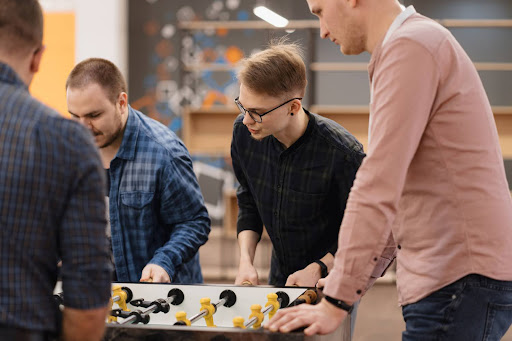
For decades, productivity at work was framed as the opposite of play. Serious work demanded seriousness in tone, environment, and behaviour. Play was something reserved for childhood or leisure time, often viewed as a distraction rather than a contributor to performance. Yet as burnout, disengagement, and cognitive overload become persistent challenges across industries, that long-held assumption is quietly being questioned.
Modern workplaces are discovering that productivity is not only about effort, discipline, and efficiency. It is also about how well people regulate stress, restore focus, and maintain psychological flexibility over time. In that context, play is no longer being reintroduced as a perk or novelty, but reconsidered as a functional mechanism that supports sustained performance.
This shift is not entirely new. Developmental psychology has long shown that play supports learning, emotional regulation, and problem-solving. Movement, curiosity, and low-stakes experimentation help the brain integrate information and recover from cognitive strain. These principles do not disappear in adulthood, even if workplaces have traditionally ignored them. It is telling that many of our earliest experiences of balance, risk, and recovery are shaped through physical play, such as climbing, swinging, or free movement, experiences that are still echoed in environments designed around motion and engagement like those offered by Swing Set Mall.
As work has become increasingly knowledge-based and emotionally demanding, the absence of these regulatory mechanisms has become harder to ignore.
Productivity Is No Longer About Continuous Output
The modern workday rarely involves long, uninterrupted stretches of focus. Instead, employees navigate constant notifications, meetings, context switching, and emotional demands. The brain is asked to perform at a high level while rarely being given the conditions it needs to reset. Over time, this leads to diminishing returns. Focus becomes brittle, creativity narrows, and even highly capable employees begin to feel depleted.
Research in cognitive science and organisational psychology increasingly points to the same conclusion: productivity depends less on sustained effort and more on effective recovery. Play, in this sense, is not about entertainment. It is about creating moments where the nervous system can shift out of a heightened state and return to balance.
Importantly, this does not require elaborate initiatives. Playful elements can be subtle, embedded into how people move, interact, and relate to their environment. Informal experimentation, humour, tactile comfort, and non-goal-oriented interaction all contribute to psychological relief. When people feel safe enough to momentarily disengage from performance pressure, they often return with sharper focus and better judgment.
The Psychological Function of Play at Work
One reason play is being re-evaluated is that it operates on a psychological level that traditional productivity tools do not reach. Software can optimise workflows, and training can improve skills, but neither addresses emotional load directly. Play does.
Play introduces low-stakes interaction. It signals that not every moment is being measured or evaluated. This reduces cognitive defensiveness, allowing people to think more openly and respond more creatively. It also provides sensory grounding, which is increasingly relevant as work becomes more abstract and screen-based.
This explains why comfort objects, soft textures, and familiar forms are gaining traction even in adult spaces. Items associated with calm and emotional safety can help regulate stress responses, particularly during periods of uncertainty or pressure. The growing appeal of collections like Jellycat Dinos and Dragons among adults reflects this shift. While traditionally associated with children, such items offer tactile reassurance and emotional neutrality that many adults instinctively seek in demanding environments. The presence of these objects is less about nostalgia and more about nervous system regulation.
Play, Trust, and Team Performance
High-performing teams tend to exhibit one defining characteristic: psychological safety. Team members feel able to speak, experiment, and recover from mistakes without fear of disproportionate consequences. Play supports this by lowering perceived risk. When teams engage in light, playful interaction, they reinforce trust and human connection, both of which are essential for collaboration.
This does not mean turning work into games or forcing artificial fun. In fact, performative play can be counterproductive. What matters is permission. Permission to explore ideas without immediate judgment, to move between intensity and ease, and to acknowledge that mental energy fluctuates.
Leaders play a critical role here. When leaders model flexibility, humour, and self-regulation, they legitimise those behaviours for others. When they equate seriousness with value, teams learn to suppress the very behaviours that could sustain performance in the long term.
Recruitment and Retention Implications
From a recruitment perspective, the re-evaluation of play has practical implications. Candidates increasingly assess employers not only on salary or role scope, but on how work feels day to day. Environments that allow space for recovery, curiosity, and human expression are perceived as more sustainable.
Retention data supports this. Employees are more likely to stay in organisations where they feel energised rather than depleted. Playful elements, when integrated authentically, contribute to that sense of energy. They also signal a broader organisational mindset that values people as humans, not just resources.
Importantly, this does not undermine professionalism. On the contrary, it supports it. A workforce that can reset psychologically is better equipped to handle complexity, pressure, and change.
Reframing Play as a Strategic Asset
The re-evaluation of play reflects a broader evolution in how productivity is understood. Output alone is no longer the metric that matters most. Sustainability, adaptability, and quality of thinking are equally important. Play supports all three.
As workplaces continue to navigate rapid change, emotional strain, and increasing cognitive demands, the ability to integrate moments of play will become a competitive advantage. Not because play replaces work, but because it makes work possible at a higher level for longer periods of time.
In that sense, play is not a distraction from productivity. It is one of its quiet foundations.