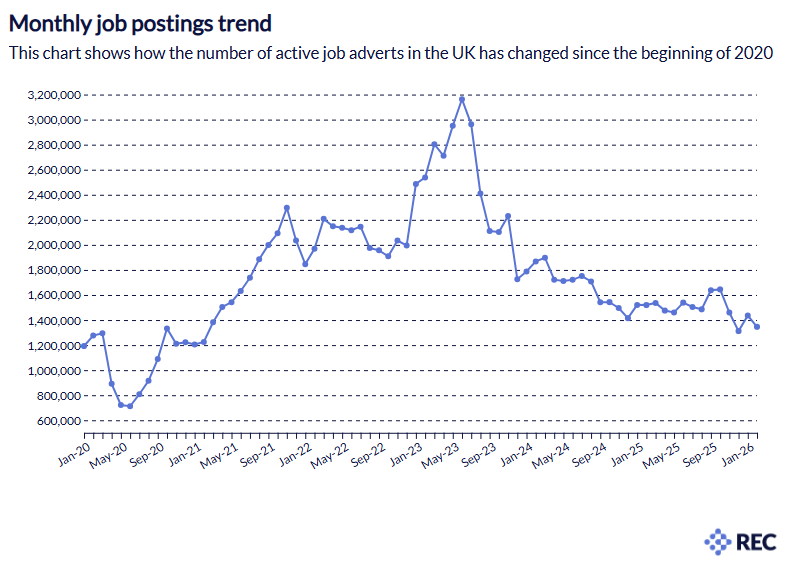
- The total number of active job postings in February 2026 stood at 1,530,172 representing 5% increase from January 2026.
- The top five hiring hotspots, based on growth in active job postings in February 2026, were: Na h‑Eileanan Siar (54.8%), Isle of Wight (18.6%), West Essex (16.2%), Buckinghamshire CC (15%), and Antrim and Newtownabbey (14.9%).
- The sharpest declines in job postings were recorded in Gwynedd (-22%), Fermanagh and Omagh (-20.6%), Dumfries and Galloway (-20.5%), Causeway Coast and Glens (-19.1%), and South West Wales (-15.3%).
- Similar to last month, of the ten counties with the lowest growth, only one county was in England, with the rest being in Wales, Northern Ireland and Scotland.
- Active job postings also increased by 0.7% in February 2026 when compared to February 2025.
- The number of new job postings in the UK for February 2026 totalled 744,566, this is a 1.4% decrease from January 2026. But it is about a 12% increase when compared to February 2025, which had 664,305 unique jobs posted.
The more than 1.5 million active job postings in February 2026 were up on the previous month, according to the latest Recruitment & Employment Confederation (REC) Labour Market Tracker.
The labour market maintained its momentum In February, with more opportunities for jobseekers.
Employers who previously paused or delayed hiring at the end of last year looked to recruit again. The reason for this renewed activity is a short period of relative economic calm in the UK during the first quarter of the year before the onset of the current crisis in the Arabian Gulf. This stability made businesses feel a bit more confident about adding staff. And it suggests that the Chancellor made the right call to have a trimmed down Spring Statement with no major tax or spend announcements.
The number of active job postings in February 2026 was up slightly in comparison to January 2026 (which had 1,457,484 active job postings). There has been a rise in blue‑collar and hospitality workers in February 2026, as well as growth in more manual jobs in the manufacturing and engineering sector. Active job postings in February 2026 were up 0.7% on February 2025.
Some of the sectors that have been targeted by the government’s industrial strategy are showing a growth in job postings.
REC Chief Executive Neil Carberry said:
“There were growing signs in February of firms seeking to add people at a faster rate. But this progress will be tested by uncertainty and a supply‑chain squeeze arising from the conflict in the Gulf. Business and government will need to work closely together in the coming weeks to manage these disruptions to deliver a better business environment in the UK this year, especially as anticipated interest rate falls are not now likely.
“Policymakers can help by making hiring easier for firms. Employment costs keep rising, so it is no surprise that unemployment is also up. Unnecessary frictions will only weaken the labour market – protecting the flexibility and focus of our jobs market has always seen us through moments like this and we need to commit to that strategy again. Businesses want government to act to make sure its Employment Rights Act is pragmatic, especially the sweeping powers for flexible workers to demand to be employed by companies who have never hired them. The threat of this is likely to slow hiring of workers at the margins, most often young people. Leaving agency workers out of guaranteed‑hours proposals, or delivering a significantly different regime for them, would protect opportunities and investment.”
Today’s Labour Market Tracker shows that the top three occupations with an increase in job postings in February 2026 when compared to January 2026, were Businesses Sales Executives (63.7%), Exam Invigilators (58.6%), and Train and Tram Drivers (46.7%).
But Actors, Entertainers and presenters (-25.5%), Marketing, Sales and Advertising Directors (-23.7%), and Photographers, Audio-visual broadcasting equipment operators (-17.2%) all shrunk in demand the most from January 2026 to February 2026.
Western Isles’ Na h-Eileanan Sair (54.8%), Isle of Wight (18.6%), West Essex (16.2%), Buckinghamshire CC (15%) and Antrim and Newtownabbey (14.9%) all saw the biggest increase in active job posting. Na h-Eileanan Sair is notable here as in January 2026 it was in the lowest three counties for growth last month with -16.5%.
Gwynedd (-22%), Fermanagh and Omagh (-20.6%), Dumfries and Galloway (-20.5%), Causeway Coast and Glens (-19.1%) and South West Wales (-15.3%) all contracted for active job postings in February 2026.
Sectors:
This month's Labour Market Tracker looks at three key sectors in the government’s Industrial Strategy.
Manufacturing:
Manufacturing has seen a 6.5% increase in jobs from January 2026 to February 2026 and has seen a total of 62,824 active job postings within the sector in February 2026. The jobs with the most growth in demand from January 2026 to February 2026 were Elementary Process Plant Occupations n.e.c. (17.7%), Mobile Machine Drivers and Operatives n.e.c. (14.9%), Production, Factory and Assembly Supervisors (14.8%).
Conversely, the occupations with the least demand in February were Planning, Process and Production Technicians (-4.8%), Mining and Quarry Workers and Related Operatives (-0.4%), and Engineering Professionals n.e.c. (-0.4%).
There was a decrease in demand for manufacturing‑related occupations between November to December 2025 (-1.7%) but the industry picked back up in December 2025 to January 2026 (6.3%).
Engineering:
Engineering has been covered in the past two Labour Market Trackers where a decline between November 2025 and December 2025 was observed. The sector has recovered from this, as there was a 5.1% increase from January 2026 to February 2026, making this the second month of increased demand.
February has a total of 127,163 vacancies, with most of the demand being driven by more practical skills. The jobs with the most growth were Pipe Fitters (22.7%), Building and Civil Engineering Technicians (22.5%), and Production Managers and Directors in Mining and Energy (20.4%).
The jobs with the lowest growth were Planning, Process and Production Technicians (-4.8%), Electrical and Electronics Technicians (-0.6%), and Engineering Professionals n.e.c. (-0.4%).
Creative industries:
The creative industries are part of the government industrial strategy as they are aiming to promote the integration of technology into creative spaces.
Currently the creative industry has 10,492 active jobs, and demand decreased between January 2026 and February 2026 marginally, by -1.7%. The jobs with the most increased demand from January 2026 to February 2026 were Archivists, Conservators and Curators (33.6%), Arts Officers, Producers and Directors (9.5%), Authors, Writers and Translators (7.4%). The occupations with the least demand were Actors, Entertainers and Presenters (-25.5%), Marketing, Sales and Advertising Directors (-23.7%) and Photographers, Audio‑visual and Broadcasting Equipment Operators (-17.2%).