Something has shifted in the interview room, and most recruiters haven't caught on yet. Candidates are walking into calls with sharper answers, tighter stories, and a level of preparation that would have been unusual even two years ago. The reason isn't that talent suddenly got better at interviewing overnight. It's that they've started using AI to practise.
Tools like AI Copilot now let candidates rehearse answers to role-specific questions, get real-time feedback on their delivery, and refine their responses until they sound natural. It's not cheating. It's preparation on a scale that the recruitment industry hasn't fully reckoned with.
What Candidates Are Actually Doing
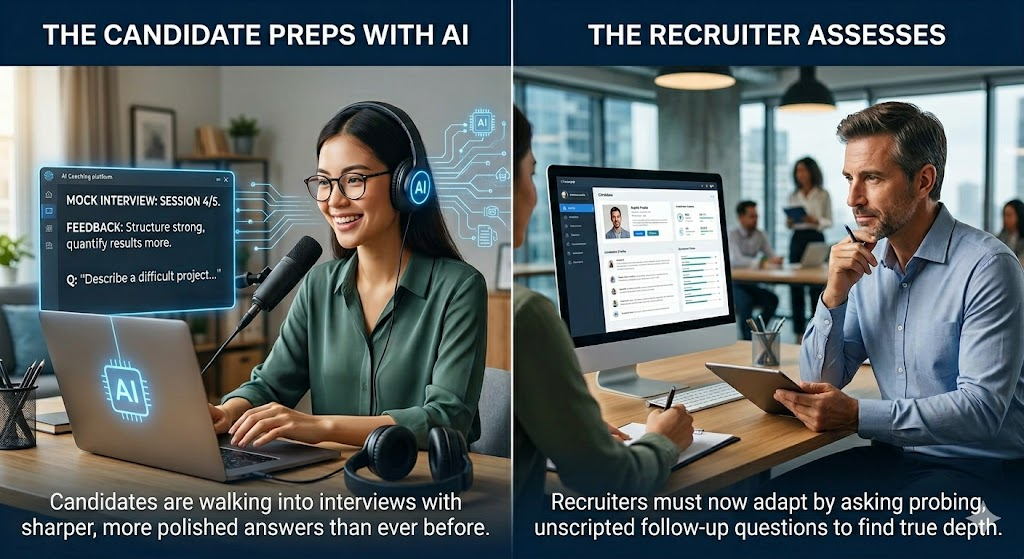
To understand the shift, it helps to look at what these tools actually offer. A candidate applying for a product management role, for example, can load up an AI prep tool and run through a simulated interview tailored to that exact position. The AI asks questions drawn from common frameworks for that role, listens to or reads the candidate's answer, and then gives structured feedback: too vague here, missing a metric there, strong opening but the closing fell flat.
This isn't a candidate reading a blog post about "top 10 interview tips" the night before. This is repeated, targeted practice with feedback loops that actually improve performance. Some of these tools can run through dozens of mock questions in a single session, covering behavioural, technical, and situational scenarios. By the time the candidate sits down with a recruiter, they've already been through the equivalent of five or six practice rounds.
What makes this different from traditional prep is the accessibility. A decade ago, this kind of targeted coaching was only available through expensive career consultants or a well-connected mentor who happened to work in the same field. Now any candidate with a laptop can access it for the cost of a coffee. That's democratised interview performance in ways the industry is only beginning to feel.
The result? Recruiters are seeing candidates who sound more polished across the board. First-round pass rates are climbing. And the traditional ability to separate strong candidates from average ones based on interview composure alone is becoming less reliable.
Why This Matters for Recruiters in 2026?
If every candidate sounds good, the recruiter's job gets harder, not easier. The interview has traditionally been a filtering mechanism. When a candidate stumbles on a competency question or can't articulate their experience clearly, that tells you something. But when AI-coached candidates deliver clean, structured answers every time, the signal-to-noise ratio drops.
This doesn't mean the interview is dead. It means recruiters need to rethink what they're screening for. A well-rehearsed STAR answer tells you the candidate prepared. It doesn't necessarily tell you they can do the job. The recruiters who adapt will be the ones who shift their evaluation criteria: less weight on delivery, more weight on depth. Follow-up questions become the real test. Can the candidate go off-script? Can they handle a scenario they didn't practise for? Can they think on their feet when you push past the rehearsed layer?
That's the new skill recruiters need to develop. Not better scripted questions, but better unscripted ones.
The Layoff Factor Is Accelerating This
There's another dimension to this that recruiters working in the current market should understand. The wave of tech and corporate layoffs over the past two years has flooded the market with experienced professionals who are highly motivated and willing to invest time in preparation. Many of these candidates are using AI tools not because they lack ability, but because they're competing in a tighter market and want every edge they can get.
For recruiters, this means the talent pool is deeper and more prepared than it's been in years. That's good news if you know how to evaluate beyond surface-level polish. It's a problem if your screening process still relies on first impressions and gut feel.
It also means that the candidates reaching your pipeline have often been through multiple rejection cycles already. They've refined their stories, tightened their positioning, and in many cases used AI tools to systematically address every weakness a previous interviewer flagged. The candidate you're meeting today is a more polished version of the one someone else passed on three months ago.
What Smart Recruiters Are Doing Differently
The best recruiters aren't resisting this trend but also learning from it. Here's what that looks like in practice.
First, they're trying the tools themselves. If you haven't sat down with an AI interview prep platform and run through a mock interview for one of the roles you recruit for, you should. Understanding what candidates are practising with gives you a direct window into what their rehearsed answers will sound like. It also helps you identify where the gaps are and where your follow-up questions can dig deeper.
Second, they're designing interviews that reward depth over delivery. Instead of asking "Tell me about a time you led a team through a challenge," they're asking the candidate to walk through a specific project in granular detail, then probing the decisions, trade-offs, and outcomes. Rehearsed candidates can start strong, but it's the unrehearsed follow-ups that reveal whether someone truly owns their experience.
Third, they're shifting evaluation weight toward live problem-solving. Case studies, real-time exercises, and scenario-based tasks are harder to prepare for because they require genuine capability, not memorised frameworks. The interview becomes a working session rather than a performance.
Finally, they're recommending prep tools to their own candidates. This might sound counterintuitive, but there's a strategic logic to it. A recruiter who helps a candidate prepare well is a recruiter whose candidates convert at higher rates. If you're placing candidates with clients, you want them to perform. Pointing a strong-but-nervous candidate toward an AI coaching tool before their final round isn't undermining the process. It's improving outcomes for everyone involved.
So, how can you prepare yourself?
AI interview preparation is not a fad. It's following the same trajectory as every other AI-assisted workflow: it starts as an advantage for early adopters and quickly becomes the baseline expectation. Within the next year or two, walking into an interview without having used some form of AI-assisted preparation will be like showing up without having researched the company. It'll be the exception, not the norm.
Recruiters who understand this now have a window to adapt their processes, sharpen their evaluation techniques, and position themselves as partners who understand the modern candidate experience. Those who don't will find themselves increasingly unable to differentiate between candidates who are genuinely strong and candidates who are simply well-rehearsed.
The interview isn't going away. But the rules of the game have changed. The question for every recruiter reading this is straightforward: are you going to adapt before your competitors do, or after?