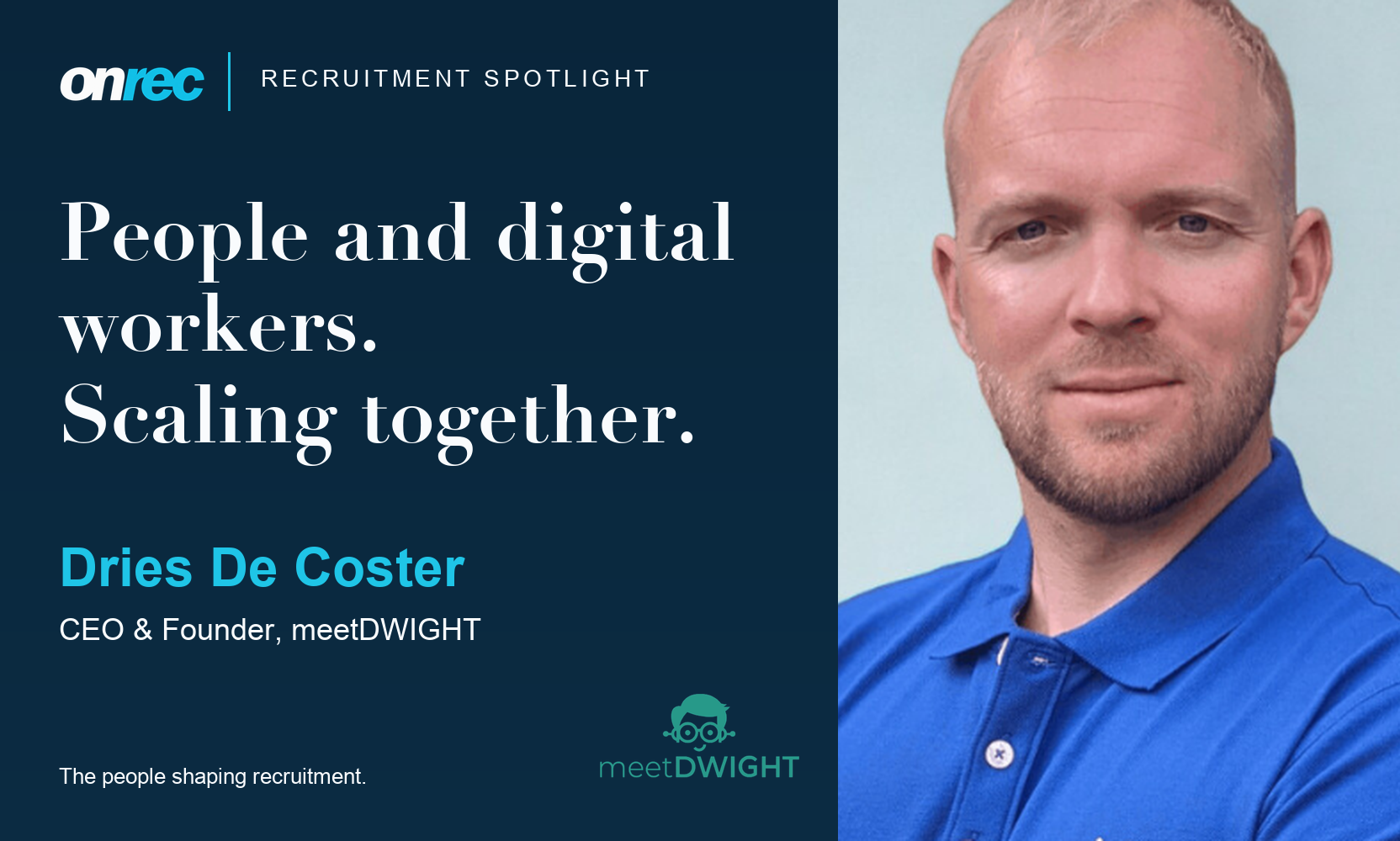
Better candidate experience starts behind the scenes, argues meetDWIGHT founder Dries De Coster. In this conversation, he explains how onboarding, compliance and payroll shape recruitment performance — and where Digital Workers can help businesses grow.
“Candidate experience is often discussed as a front-end problem, but it’s really an operational one.”
Dries De Coster
The operational challenge
What led you to found meetDWIGHT?
I’ve spent most of my career in the Human Capital Management space, working closely with recruitment and staffing businesses, particularly around operations, systems, and scaling challenges. One thing became very clear early on: the industry is incredibly people-driven, but the operational backbone is often held together by manual processes, disconnected systems, and significant administrative burden.
As firms grew, they didn’t necessarily become more efficient, they just added more people to manage the workload. That creates margin pressure, slows down delivery, and introduces risk.
meet DWIGHT was founded to solve that. We wanted to create a way for organisations to scale operations without scaling headcount in the same way. That’s where the concept of Digital Workers came in, software that can perform structured, repeatable tasks across systems, 24 hours a day, with full auditability and control.
What does meetDWIGHT do differently?
meet DWIGHT provides Digital Worker Bots that automate middle and back office processes across the recruitment lifecycle, delivering tangible cost savings.
That includes things like candidate onboarding, compliance checks, timesheet processing, payroll preparation, VMS submissions, and invoicing. These are critical processes, but they’re often manual, time-consuming, and prone to error.
What makes us different is how we combine deterministic automation with agentic AI. Traditional RPA is reliable but limited. Pure AI is powerful but often unpredictable. We bring those two together in a governed way.
The result is automation that is both intelligent and controlled. It works across legacy and modern systems, doesn’t rely on APIs being available, and delivers consistent, auditable outcomes. That’s particularly important in regulated sectors like staffing and healthcare.
Where are organisations struggling most?
The biggest challenge is pressure from all sides.
People costs are rising. Margins are tightening. Candidate expectations are higher than ever. At the same time, compliance requirements continue to increase.
What we’re seeing is that many organisations are trying to solve these challenges with front-office improvements alone, better sourcing, better marketing, better engagement. Those are important, but they don’t fix the operational bottlenecks behind the scenes.
The reality is that delays in onboarding, compliance, or payroll have a direct impact on candidate experience and revenue. That’s where many organisations are still struggling.
Automation that supports the candidate experience
Where are businesses getting AI wrong?
AI is absolutely transforming how organisations engage with candidates, from personalised outreach to faster screening and communication.
Where businesses are getting it wrong is assuming that AI on its own is the solution. There’s a tendency to jump straight to fully autonomous systems without thinking about control, governance, or reliability.
In recruitment, that’s risky. You’re dealing with people, compliance, and brand reputation.
The organisations getting it right are taking a more pragmatic approach. They’re using AI to enhance processes, but anchoring it in structured workflows that ensure consistency and accountability.
How can employers improve candidate experience at scale?
Candidate experience is often discussed as a front-end problem, but it’s really an operational one.
If onboarding takes too long, if compliance checks are delayed, or if payments are incorrect or late, that’s where experience breaks down.
The most effective improvements we’re seeing come from removing friction in those processes. That includes automating onboarding workflows, ensuring compliance is completed quickly and consistently, and eliminating manual handoffs between systems.
At scale, consistency is key. Digital Workers help ensure that every candidate goes through the same high-quality process, every time.
What does a strong employer brand look like in 2026?
In 2026, employer branding is no longer just about what you say, it’s about what candidates experience.
A strong brand is one that delivers on its promises consistently. Fast onboarding, clear communication, accurate payments, and a smooth overall journey.
Candidates talk, and they remember how they were treated.
Organisations should think of their brand as an operational outcome, not just a marketing message. The best brands are built through reliable, high-quality execution at every stage of the lifecycle.
Building for scale
What problem does DWIGHT Studio solve?
DWIGHT Studio is our platform-as-a-service offering that allows organisations to build, deploy, and manage their own Digital Workers.
Historically, automation has either been fully outsourced or required significant internal technical capability. DWIGHT Studio sits in the middle. It gives organisations the tools to build automation themselves, while still having access to our expertise through structured success plans.
It solves a key problem in the market, which is how to move from isolated automation projects to a scalable, governed automation strategy.
Within the wider meet DWIGHT ecosystem, it complements our managed service offering. Some customers want us to build and run everything. Others want more control. DWIGHT Studio enables both.
What should recruitment teams measure?
The starting point is visibility.
Many organisations still don’t have a clear view of where time is being spent or where delays are occurring in their processes.
Key areas to measure include time to onboard, compliance turnaround times, time to first shift or placement, and error rates in payroll or invoicing.
Beyond that, it’s about linking operational data to commercial outcomes. For example, how does faster onboarding impact revenue? How does improved compliance speed reduce drop-off?
The organisations that win are the ones that connect operational efficiency directly to business performance.
Where should recruitment and HR leaders invest?
Start with your operations.
Before investing heavily in new front-office tools or AI solutions, make sure your core processes are efficient, scalable, and reliable.
Look at where your teams are spending time on manual, repetitive work, and prioritise automating those areas.
At the same time, invest in platforms that give you flexibility. The market is evolving quickly, and you don’t want to be locked into rigid systems.
The combination of strong operational foundations and adaptable technology is what will future-proof organisations.
What should the industry prepare for next?
What excites me most is the shift towards truly scalable operations.
For the first time, organisations can grow without being constrained by headcount in the same way. That opens up huge opportunities in terms of margin, speed, and service quality.
What the industry should be preparing for is a move towards hybrid workforces, where humans and Digital Workers operate together.
The organisations that embrace that model early, and put the right governance around it, will have a significant competitive advantage.
Quick fire with Dries De Coster
1. One word to describe the future of recruitment?
Scalability
2. Biggest hiring mistake companies still make?
Ignoring how operations impacts candidate experience
3. AI in recruitment, overhyped or underutilised?
Underutilised, but often misapplied
4. One tool or trend every TA team should be paying attention to right now?
Digital Workers
5. Coffee or tea?
Being from Belgium, tea is not a thing…
100% coffee (I’m a 2 cups a day guy – one in the morning, one just after lunchtime), but don’t try and give me a cup of the abomination that is instant coffee.
It has to be the good stuff.
To reach out to Dries, follow him LinkedIn and vistit www.meetdwight.com