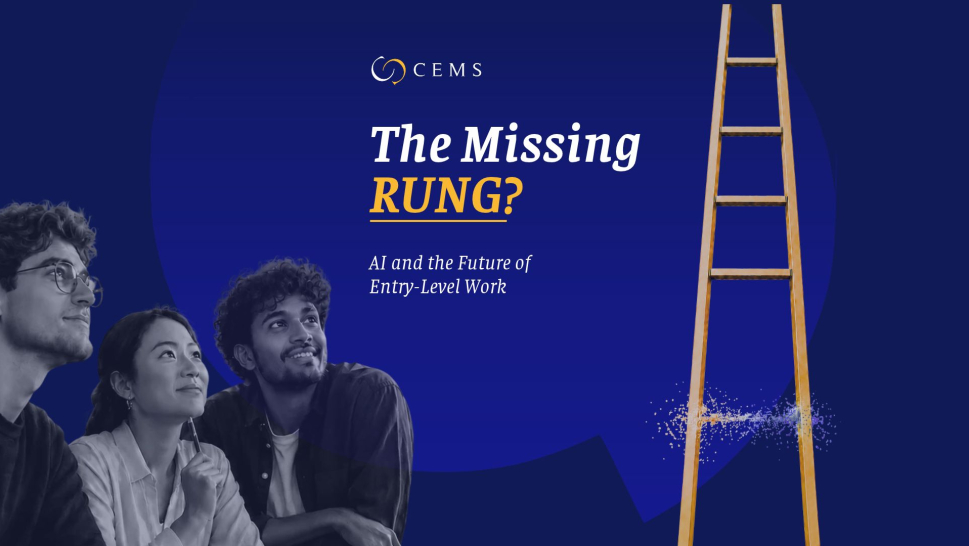
Employers that replace entry-level recruitment with AI risk weakening their future leadership pipeline, according to contributors to a new report from CEMS, the Global Alliance in Management Education.
The Missing Rung? AI and the Future of Entry-Level Work, released on 1 October, brings together interviews and research involving students in more than 20 countries, alongside perspectives from employers and academics across the alliance. It presents expert analysis rather than a representative measure of all graduate jobs.
Protect the route into leadership
Contributors argue that junior roles do more than provide capacity for routine tasks. They give people opportunities to develop independent thinking, learn an organisation’s values and build the experience needed for future management responsibilities.
Entry-level roles are far more than a way of getting work done.
Nicole de Fontaines, Executive Director, CEMS
Frank Steinert, Global Head of HR Regions at Henkel, warns in the report that removing entry-level positions could interrupt the natural progression of a company’s leaders and damage its culture over time.
Redesign the work, develop the people
The report describes routine drafting, data gathering and first-pass analysis moving into AI-supported workflows, while new responsibilities emerge around those tools. Its contributors see opportunities for graduates who can demonstrate practical AI projects, combine evidence with judgement and explain their own reasoning.
For universities, the report advocates incorporating AI into teaching and assessment while keeping each student’s thinking visible. Closer links between educators and employers are presented as a way to keep learning aligned with changing work.
Why it matters
For recruitment leaders, the practical question is how junior roles can develop the skills a business will need later. A hiring plan that considers only tasks automated today may overlook the need to build tomorrow’s managers and specialists.
The report acknowledges that the graduate market remains difficult and that some roles may disappear. Its argument is to preserve meaningful opportunities to learn as the content of early-career work changes.
Report artwork: CEMS. The launch announcement does not provide a total interview sample or fieldwork dates.