Why recruiters buy LinkedIn accounts at all
The arithmetic is simple. A single LinkedIn profile has soft limits on connection requests, messages and profile views, and LinkedIn tightens those limits on accounts it considers young, thin or unusually active. A sourcing team that needs to reach several hundred passive candidates a week either pays for Recruiter seats, runs the outreach across several personal profiles, or both. When a consultant leaves, their network leaves with them. When a profile is restricted mid-campaign, the pipeline stops.
Buying an established account is an attempt to short-cut the two slowest parts of that problem: account age and account trust. An aged LinkedIn account, registered years ago and carrying some activity history, is treated by LinkedIn's systems as less risky than one created last week. A verified account, where the email and sometimes the phone number are confirmed, clears the first checkpoint LinkedIn applies to new members. For an agency, that translates into outreach that starts at a normal pace rather than being throttled on day one.
Whether that is a good idea is a separate question, and the honest answer is that it carries real risk, which the next section covers before anything else.
What LinkedIn's rules actually say
LinkedIn's User Agreement is unambiguous. Members agree to have only one LinkedIn account, held in their real name. The agreement's Dos and Don'ts prohibit creating a false identity, creating a profile for anyone other than yourself, and using or attempting to use another person's account. It also prohibits software, scripts or bots that automate activity on the platform. A purchased account, by definition, started life as someone else's profile, so using it is a terms-of-service violation from the first login, however it was obtained.
The practical consequence is enforcement rather than litigation. LinkedIn restricts accounts it suspects of inauthentic behaviour and increasingly asks for government ID verification to restore access, which a buyer of someone else's profile cannot provide. Any agency considering this route should treat every purchased account as temporary infrastructure that can be removed without notice, keep nothing irreplaceable on it, and never run it against candidate data in a way that would breach data-protection obligations if the account were lost.
None of that stops the market existing. It does define what "a good LinkedIn account" means: one whose origin, registration country and verification state are known in advance, so that the buyer's first login does not look like a takeover.
Where the real risk sits: the first login

Most restrictions on purchased accounts are triggered in the first session, not weeks later.
Talk to anyone who has bought accounts at scale and the same pattern emerges. Accounts rarely die of old age; they die in the first session. An account registered on a US IP address logs in from a London office. A profile that has only ever been opened on one phone appears on a new laptop. The password is changed, the email is swapped, and twenty connection requests go out within the hour. Each of those is a signal LinkedIn's systems are built to detect, and together they are a near-certain restriction.
The buying criteria follow directly from that. Registration country should match where the account will be used, or the agency should budget for a proxy in the right country and the discipline to use it consistently. The original email should be included, so the account can be secured without triggering a recovery flow. Two-factor authentication, where included, should be transferred rather than reset. And the first week should look like a returning user, not a new campaign.
How to evaluate a seller
The LinkedIn account market splits into three kinds of source, and the differences matter more than price.
Forum and chat sellers are the cheapest and the least accountable. There is no listing standard, no warranty beyond the seller's word, and no recourse if the account is reclaimed by its original owner a week later.
General digital-goods marketplaces list LinkedIn accounts alongside game keys and gift cards. They offer buyer protection designed for digital goods generally, sold by third-party merchants whose account-specific knowledge varies.
Specialist account marketplaces are built around accounts specifically, which shows in the listing filters. AccsZone, for example, separates its LinkedIn catalogue into new accounts, verified accounts, aged accounts with connections and European-registered accounts, and each listing states the registration IP region, whether the email is included, whether 2FA is enabled, the gender on the profile and how complete the profile is. That is the information an agency needs to match an account to a consultant and a location before buying, and it is the information most sellers do not provide.
Whichever source is used, the same checklist applies before paying:
• Origin. Does the listing state the registration country and IP type? If not, assume a mismatch with your location.
• Verification. Email verified, phone verified, or ID verified? LinkedIn's trust ladder runs in that order, and so does durability.
• Credentials included. Is the original email address part of the package, with access? Without it, the account cannot be properly secured.
• Age and history. Is the registration year stated? Does the profile have connections, or is it an empty shell that will need warming?
• Guarantee terms. What exactly is covered, for how long, and how is a refund paid? Specialist marketplaces typically cover failure before first login only, with claims due within 24 hours and refunds as store credit; AccsZone publishes those terms on its FAQ and terms pages. A seller who will not state a window has no guarantee.
• Payment and recourse. Card and PayPal give you a chargeback route; crypto-only sellers (which includes most specialist marketplaces) do not, so the published guarantee is the only protection you have.
• Delivery. Instant, automated delivery means the account has been sitting in inventory; manual delivery means someone is registering or sourcing it after you pay, which is slower but not necessarily worse.

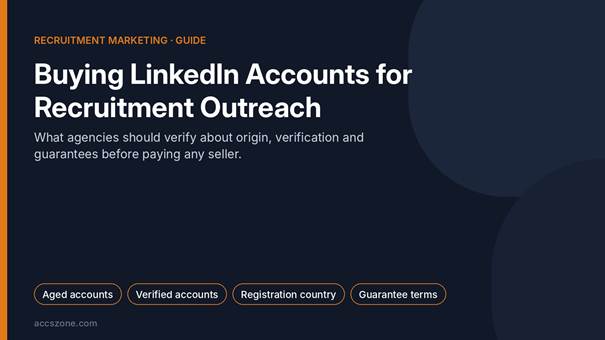
Seven questions to answer before paying any seller, whatever the source.
Aged versus new versus verified: which to buy
For recruitment outreach specifically, the ranking is not what the price list suggests. A new, empty account is cheap and almost useless; it will be throttled immediately and has no credibility with candidates. An aged account with connections costs more and behaves like a real member, but its existing network and history belong to a stranger, so it needs a profile rewrite before any candidate sees it. A verified account sits between the two: it has cleared LinkedIn's identity checks, which is the single biggest driver of durability, but it may still be thin.
Agencies that have made this work tend to buy verified or aged accounts in the country where the consultant sits, rebuild the profile with real details over a fortnight with a real photo, a real employer and a real job history before sending a single message, and treat the account as belonging to a named consultant who is accountable for how it is used. The agencies that burn through accounts buy the cheapest new ones in bulk and start messaging on day one.
The alternative worth stating
A LinkedIn Recruiter licence, used by a consultant on their own profile, breaks no rules and does not disappear when the consultant does. For a firm whose entire pipeline runs through LinkedIn, the cost of a licence is a rounding error compared with the cost of a restricted account mid-search. Buying accounts is a tactic for capacity and redundancy at the edges, not a substitute for a compliant core, and an agency that frames it that way will make better buying decisions than one looking for a shortcut.
Key takeaways
• Demand for purchased LinkedIn accounts is driven by outreach limits and account restrictions; the fix buyers are paying for is age and trust, not features.
• Every purchased account violates LinkedIn's one-account, real-name rule. Treat it as temporary infrastructure and keep nothing irreplaceable on it.
• Restrictions are triggered in the first session. Match registration country to usage location, secure the account with the original email, and behave like a returning user for the first fortnight.
• Evaluate sellers on the information in the listing: origin, verification level, included credentials, age, guarantee window, refund method and payment recourse. Specialist marketplaces such as AccsZone publish all of these; forum sellers rarely do.
• For recruitment, verified or aged accounts in the right country, rebuilt with real details before use, outlast cheap new accounts by a wide margin.
• A Recruiter licence on a consultant's own profile remains the only option with no enforcement risk.
This article describes a market and its risks for information purposes. Buying, selling or operating LinkedIn accounts that are not your own breaches LinkedIn's User Agreement and can result in permanent restriction. Readers are responsible for their own compliance with platform terms and applicable data-protection law.