Recruitment has changed significantly in the past few years. Job boards, career sites and professional networks remain important, but candidates increasingly discover employers through the content they encounter on social media.
For recruiters and talent acquisition teams, this creates an opportunity that goes beyond simply publishing job vacancies.
Instagram, in particular, can provide useful signals about professional communities, creators, industry conversations and the audiences surrounding an employer brand. When used carefully and responsibly, it can become another channel for candidate research and talent attraction.
The challenge is turning a fast-moving social platform into a practical part of the recruitment workflow without creating unnecessary manual work.
Why Instagram Matters to Modern Recruitment
Instagram may not be the first platform recruiters think about when sourcing candidates, but its role in employer branding continues to evolve.
Candidates can discover companies through employee content, workplace stories, industry creators, career-related posts and company culture content long before they visit a careers page.
This makes Instagram particularly interesting for organisations hiring in industries where visual content, community and personal brand matter.
Recruiters can use Instagram to understand:
-
which communities are interested in a particular industry;
-
which creators influence conversations around a profession;
-
how competitors present their employer brand;
-
which types of content attract engagement;
-
where potential candidates spend time online;
-
how a company's social presence compares with competitors.
The purpose is not to replace traditional candidate sourcing channels. Instead, Instagram can provide another layer of context.
From Candidate Search to Community Research
One of the biggest changes in social recruiting is the shift from searching only for individual candidates to understanding the communities around a particular profession.
Consider a company hiring software developers.
Instead of looking only for people who have already applied for a role, a recruiter could research technology creators, developer communities, coding-related accounts and professional conversations on Instagram.
The same principle can apply to designers, marketers, hospitality professionals, fitness specialists, photographers, healthcare professionals and other visually oriented industries.
Community research can help recruiters answer a more fundamental question:
Where does the talent we want to reach actually spend its time online?
Once that is understood, recruitment marketing can become much more targeted.
Why Follower Research Can Be Useful
Public follower and following lists can provide one possible starting point for community research.
For example, a recruiter researching a niche professional creator may want to understand the type of audience surrounding that account. A company researching a competitor's employer-branding strategy may also want to examine the communities engaging with similar content.
For teams that need to organise this information across multiple accounts, an IG follower export tool can make the initial research process more manageable.
Rather than manually copying usernames from individual profiles, recruiters can organise available follower and following information for further review.
The value is not in creating the biggest possible list. The goal is to create a dataset that helps the recruitment team understand a particular community.
Turning Social Data Into Recruitment Intelligence
Once information has been organised, recruiters can add their own context.
For example, a research spreadsheet could include fields such as:
-
Instagram username;
-
profile URL;
-
relevant industry;
-
creator or community;
-
location, where publicly available and relevant;
-
potential relevance to a campaign;
-
content category;
-
research notes.
This can help transform a collection of social profiles into a more useful research resource.
A recruitment agency might use this process when entering a new specialist market. An internal talent team might use it when developing an employer-branding campaign for a difficult-to-fill role.
Again, the objective is not to automatically label people as candidates.
It is to understand communities and identify where a recruitment message may be relevant.
Make Repeated Instagram Research More Efficient
The process becomes particularly time-consuming when recruiters need to research multiple accounts or repeat the same activity for different hiring campaigns.
In that situation, working directly from the browser can make the workflow easier to repeat.
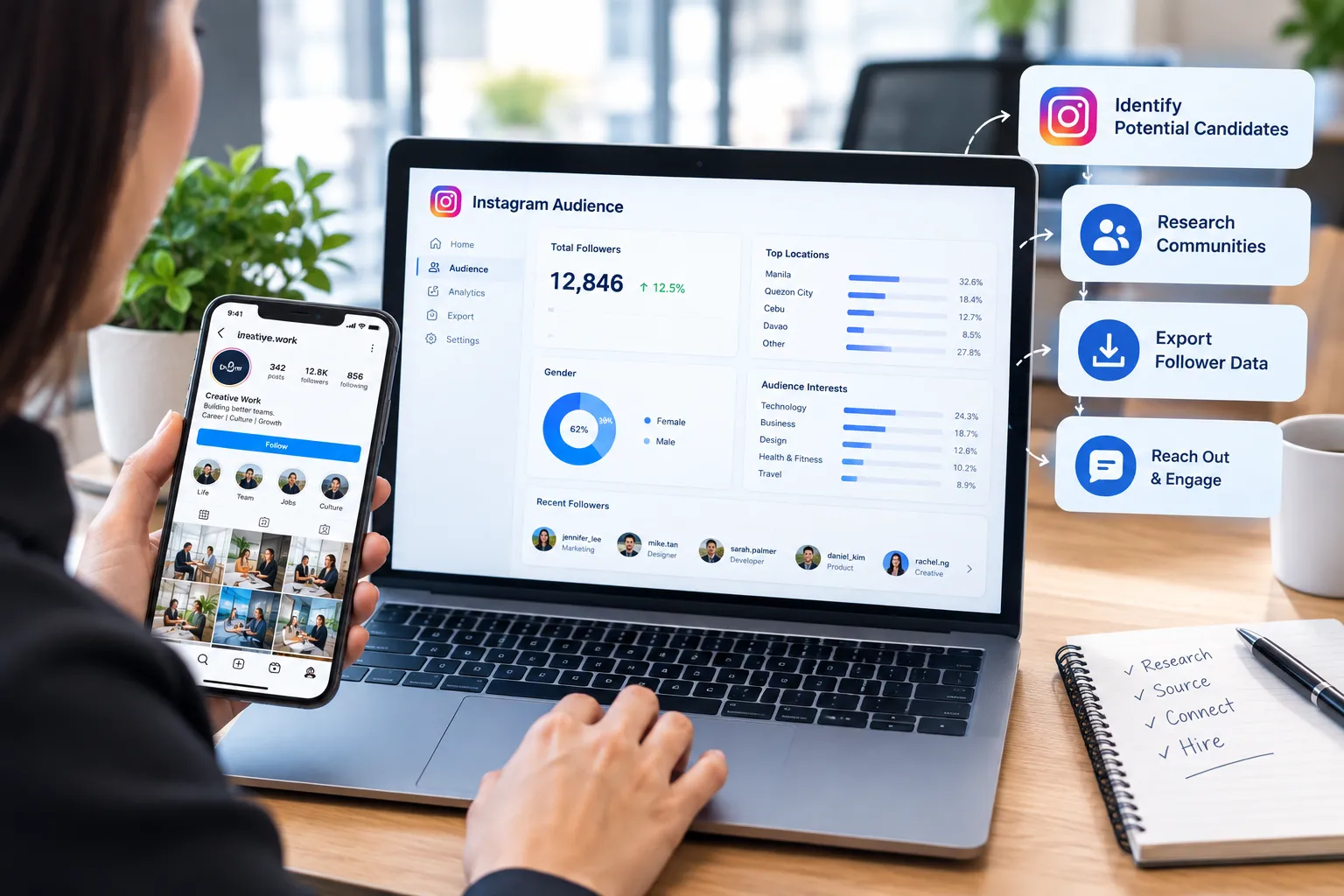
A Chrome-based ig follower export tool can help recruiters work with follower and following lists while browsing Instagram.
A repeatable workflow might look like this:
-
Identify relevant professional communities and creators.
-
Review the associated Instagram audiences.
-
Export useful follower or following information.
-
Organise the results into a research spreadsheet.
-
Remove irrelevant or duplicate accounts.
-
Identify useful communities and potential campaign audiences.
-
Develop content or outreach based on the research.
This can reduce repetitive administrative work while keeping the recruitment team's attention on analysis and strategy.
A More Connected Recruitment Workflow
Instagram research becomes more valuable when it is connected to the wider recruitment strategy.
A modern talent acquisition workflow might look like:
Research → Understand → Attract → Engage → Evaluate
Social media can support the first three stages particularly well.
Recruiters can research relevant communities, understand what matters to their target audience and create employer-brand content that attracts attention.
Professional networks, career sites and recruitment platforms can then continue the candidate journey.
This creates a more connected experience than relying on a single channel.
Measuring What Actually Matters
Recruitment teams should also avoid measuring social recruiting only by follower counts.
A larger audience does not necessarily mean a better talent pipeline.
More useful indicators may include:
-
engagement from relevant professional audiences;
-
traffic to career pages;
-
applications generated from social campaigns;
-
qualified candidate interest;
-
employer-brand engagement;
-
response rates from relevant outreach;
-
quality of candidates entering the recruitment funnel.
The exact metrics will depend on the organisation and hiring campaign.
The important point is to connect social activity to actual recruitment objectives.
The Future of Social Recruiting Is More Targeted
As recruitment becomes increasingly digital, recruiters have access to more channels than ever before.
The challenge is no longer simply finding more people. It is finding the right people, understanding their context and communicating with them in a way that feels relevant.
Instagram can play a useful role in that process, particularly for employer branding, community research and talent attraction.
Tools that simplify follower research can reduce repetitive manual work, but technology should support rather than replace recruiter judgment.
The strongest approach combines structured data with human understanding.
Ultimately, effective social recruiting is not about collecting the largest number of profiles or sending the most messages.
It is about finding the right communities, creating meaningful connections and giving potential candidates a reason to pay attention.