In the United States, the star rating, the review count, the most recent comments and the owner's replies usually form the entire first impression of a local business — and the decision to call, book or walk in often happens inside fifteen seconds, without the customer ever leaving the search results.
A stronger review profile supports trust, local visibility and conversion when it sits alongside accurate business details, current photos, responsive service and reviews from real customers. The obstacle for most small businesses is not that customers are unwilling to review them. It is friction. People intend to leave a review from the parking lot, and the moment passes.
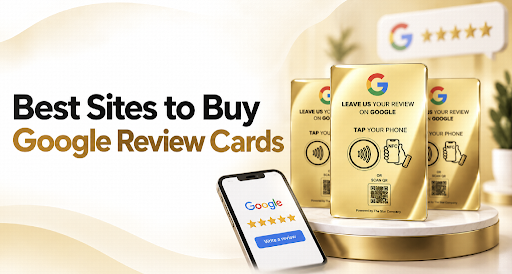
Review cards, plates and stands exist to close that gap: a physical prompt at the counter that takes a satisfied customer straight to the review box while they are still standing there. The category has expanded quickly and the products differ far more than the marketing suggests.
This comparison covers five ways to collect Google reviews at the point of service, with pricing, durability, technology, strengths, limitations and best-fit use cases.
Quick Option Snapshot
-
The Star Company: Full hardware range — engraved metal plates, NFC review cards, countertop stands and signs — programmed with the direct review link, one-time purchase, no subscription.
-
Marketplace generics (Amazon, eBay): Lowest entry price for blank or lightly branded NFC cards and stickers, usually self-programmed.
-
Etsy custom sellers: Made-to-order acrylic plates and stands with custom logos, wide quality range, longer lead times.
-
Subscription review platforms: Podium, Birdeye and similar tools that bundle hardware into monthly customer-messaging plans.
-
DIY printed QR codes: Free, immediate, and the right way to test placement and staff habit before spending anything on hardware.
Comparison Table
|
Option |
Typical Price |
Technology |
Durability |
Best Match |
|
The Star Company |
~$30–$75 one-time |
NFC + QR |
High (metal, acrylic) |
Businesses wanting permanent hardware and a correctly programmed link |
|
Marketplace generics |
$5–$25 one-time |
NFC or QR |
Low to medium |
Cheap testing, or owners comfortable self-programming |
|
Etsy custom sellers |
$13–$48 one-time |
NFC + QR |
Medium to high |
Businesses wanting a specific custom design |
|
Subscription platforms |
$50–$300/month |
Software + hardware |
N/A |
Multi-location operations running centralized messaging |
|
DIY printed QR |
Free |
QR only |
Very low |
Proving the system works before buying |
The right choice depends less on budget than on what stage the business is at. A business that has never asked for a review at the counter should not start with hardware. A business that already has the habit and is losing prompts to worn-out paper should not still be printing.
Option Breakdown
1. The Star Company — Full Hardware Range
The most complete product range in the category, and the one that addresses the problem most competitors ignore: which link the product is actually programmed with.
Most cheap review cards are encoded with the business's Google Business Profile URL. Tap or scan one and the customer lands on the full listing — photos, hours, directions, phone number, map — with the "Write a review" button somewhere further down the page. That is four or five taps before anyone types anything, and a substantial share of customers never get there. The Star Company programs the direct review link instead, which opens the star selector immediately.
Pricing
|
Product |
Typical Price |
Placement |
|
~$30–$70 |
Bill folders, handed across a counter |
|
|
Engraved metal plates |
~$60–$75 |
Permanent register or reception placement |
|
Countertop stands |
~$60–$70 |
Tables, checkout counters |
|
Table signs |
~$30–$65 |
Restaurant tables, waiting rooms |
Highlights. Every product carries both NFC and QR on the same item, so it works regardless of the customer's phone. Nothing requires an app on either side. Pricing is one-time — there is no monthly plan and no platform login to maintain. A 22K gold-plated version of the metal plate sits at the top of the range for businesses that want the counter piece to look like a fixture rather than signage.
The company also publishes free tools, including a Google review QR code generator and a review count calculator, which are useful before buying anything.
Strengths
-
Direct review link programmed as standard
-
NFC and QR on every product
-
One-time cost, no subscription
-
Metal and acrylic construction built for permanent placement
-
Range covers counter, table and wall placement
-
No app required for the customer
-
Free tools available to test the approach first
Practical considerations
-
Higher upfront cost than marketplace alternatives
-
Physical products mean shipping time before you can start
-
Hardware solves the prompt, not the asking — staff still need to mention it
-
A permanent plate is harder to reposition than a card if the placement turns out wrong
Best fit. Restaurants, salons, barbershops, dental and medical practices, auto shops, retail stores and contractors that want durable hardware, correct programming and no recurring bill.
2. Marketplace Generics — Amazon and eBay
The cheapest entry into the category. Blank or lightly branded NFC cards typically run $5 to $25, with multi-packs of NFC stickers at similar prices.
Pricing
|
Product |
Typical Price |
|
Single NFC review card |
$5–$16 |
|
NFC review sticker packs (10–20) |
$20–$36 |
|
Basic NFC stand |
$25–$32 |
Highlights. Fast shipping, low commitment, and easy to buy several to test placements. Most are NTAG213 or NTAG215 chips — the same components used across the category — so the hardware itself is usually fine.
Practical considerations
-
Programming is typically your responsibility, which is exactly where most businesses end up encoding the listing URL instead of the review link
-
Print and material quality vary considerably between sellers
-
Branding is generic or absent
-
Little to no support after delivery
-
Many listings are the same white-label product at different markups
Best fit. Owners comfortable programming tags themselves, or businesses that want to test the concept for under $20 before committing.
3. Etsy Custom Sellers
A large and genuinely competitive segment. Custom acrylic plates, coasters and stands with your logo typically run $13 to $48, with established shops carrying thousands of sales.
Pricing
|
Product |
Typical Price |
|
NFC review card, custom logo |
$5–$13 |
|
Acrylic review plate or sign |
$19–$48 |
|
Mini NFC table coaster |
$17–$20 |
|
NFC review keychain |
$12 |
Highlights. The strongest option for a specific custom design. Shops with long sales histories and visible review counts are straightforward to vet, and the work from established sellers is often very good.
Practical considerations
-
Quality range is wide; newer listings are frequently dropshipped from the same suppliers as marketplace cards at a markup
-
Made-to-order means longer lead times
-
Support after delivery is inconsistent
-
Confirm which link gets programmed before ordering — the same listing-URL problem applies here
-
Reordering identical items later depends on the seller still trading
Best fit. Businesses that want a particular look and are willing to vet an individual seller's history.
4. Subscription Review Platforms
Podium, Birdeye and similar tools bundle review requests into broader customer messaging — SMS campaigns, shared inbox, automated follow-up, analytics — and typically include hardware as part of the plan.
Pricing. Plans generally start in the $50–$100 per month range and rise past $300 depending on features and locations. Pricing is usually quote-based rather than published.
Highlights. These are substantial products, not review gadgets. Automated post-visit review requests by text convert well, the analytics are real, and centralized response management genuinely helps operations running several locations.
Practical considerations
-
Recurring cost for a problem a one-time purchase can solve at a single site
-
Contract terms are often annual
-
The value sits in the software; the hardware is incidental
-
Overkill for a single café, salon or shop
-
Migrating away later means losing the automation you built the process around
Best fit. Multi-location businesses and franchises already running centralized customer messaging.
5. DIY Printed QR Codes
Free, immediate, and the most underrated option in the category — not as a permanent solution, but as the first step.
Highlights. Generate your direct review link, produce a QR code, print it, and put it on the counter. If the sequence works — if customers scan, if staff remember to mention it, if the placement is right — you have proof before spending anything. A free Google review QR code generator returns both the direct link and a printable code without an account.
Practical considerations
-
Paper curls, absorbs spills and gets buried under receipts
-
After a few weeks it stops reading as part of the business, and staff stop pointing at it
-
No NFC, so no tap option
-
Needs reprinting regularly
-
Print quality affects scan reliability more than people expect
Best fit. Every business, as a two-week trial before buying hardware.
The Detail That Decides Everything: Direct Link vs Listing URL
This deserves its own section because it is the single biggest differentiator in the category and almost nobody advertises it.
There are two links you can encode. The Business Profile URL is what you get by searching your own business and copying the address bar. It opens your listing. The direct review link opens the star selector immediately, over your listing, with nothing in between — tap the fourth star and the review box is already open.
Three ways to get the direct link:
From your Business Profile. Sign in with the account managing the listing, search your business name, and look for the "Ask for reviews" option in the management panel. Google generates a short link. The interface has moved several times in recent years, which is why many owners give up looking.
Via your Place ID. Every business on Maps has a unique identifier. Once you have it, the review URL follows a fixed pattern that never breaks. It is the most reliable method and requires digging through Google's developer tools.
With a generator. Search your business name, get the link and code back, no account needed.
Whichever route you take, test before printing or ordering. Scan the code with your own phone. Five stars ready to tap means you are set. Photos and opening hours means you have the listing URL and need to start again. This single check saves most businesses a wasted order.
Why Review Volume Affects Local Visibility
Review count functions as a legitimacy signal. A business at 4.6 stars with 40 reviews routinely loses to a competitor at 4.4 with 400, because volume reads as an established operation while a thin profile reads as new, quiet or possibly closed.
Recency compounds this. A stack of reviews that stopped eighteen months ago suggests a business that may not still operate the way those reviews describe. A profile with feedback from the past few weeks looks active.
Neither replaces the rest of the listing. Updated hours, current photos, correct service details and a working phone number all contribute. Reviews work best when the full profile looks maintained.
Google Compared With Other Review Platforms
|
Platform |
Strongest Use Case |
Visibility Value |
Main Limitation |
|
|
Local discovery and Maps |
Very high |
Strict content policies |
|
Yelp |
Restaurants and selected services |
Strong in some categories |
Aggressive filtering |
|
|
Community-driven brands |
Good social proof |
Peripheral to Maps discovery |
|
Trustpilot |
Ecommerce and national brands |
Strong for brand research |
Separate from local search |
A complete reputation approach may use more than one. For businesses that depend on local foot traffic, Google carries the most weight because the reviews appear exactly where the customer is already searching.
Placement by Business Type
The rule is to put the prompt where the customer is most satisfied, which is rarely where it is convenient and almost never the front door.
Restaurants and cafés. Inside the bill folder or printed on the receipt. The front counter is too early — the meal is the reason they would review you.
Salons and barbershops. At the mirror during the final check, when the customer is looking directly at the result. This is the highest-intent moment in any service business.
Auto repair. Handed over with the keys alongside the invoice. Relief at a finished repair is a strong prompt.
Dental and medical practices. At checkout rather than in the waiting room. Nobody reviews a practice before treatment.
Retail. At the register during bagging, where there is a natural pause.
Trades and mobile services. There is no counter, so the prompt is a follow-up text the same afternoon with the direct link in it.
One prompt placed at the moment of satisfaction outperforms five scattered around the building.
The Part Hardware Cannot Do
A card sitting silently on a counter converts at a fraction of the rate of the same card when a staff member points at it and says one sentence.
The sentence does not need to be clever: "If you've got ten seconds, this takes you right there — it really helps us." Train it once, place the prompt where the handoff naturally happens, and let the team do the asking. The hardware removes friction from the yes; it does not generate the yes.
Common Mistakes to Avoid
Encoding the wrong link. The most expensive mistake in the category, because it silently halves results and looks like the product failing.
Wrong placement. Front doors and entrances catch people before they have anything to review.
Buying hardware before building the habit. If nobody asks, a metal plate performs exactly as well as no plate at all.
Offering incentives. Discounts, free items or prize entries in exchange for reviews violate Google's policies. Reviews can be removed, sometimes including legitimate ones.
Review gating. Asking how the experience was and only showing the prompt to customers who answer positively is explicitly prohibited by Google. Ask everyone, consistently.
Buying reviews outright. Beyond Google's policies, the FTC's rule on fake and paid consumer reviews carries civil penalties for US businesses. It is also self-defeating — purchased reviews are generic, and customers notice.
Ignoring owner responses. Unanswered reviews make a profile look inactive. A calm, brief reply to criticism does more for undecided customers than the complaint does against you.
Frequently Asked Questions
How do I find my Google review link? Through your Business Profile's "Ask for reviews" option, by constructing it from your Place ID, or with a free generator. Test it before printing — it should open the star selector directly.
Do NFC review cards work on iPhone? On iPhone XR and newer, yes, natively. Older models need NFC enabled from Control Center. This is why products carrying both NFC and QR are the safer buy.
Is it against Google's policy to ask customers for reviews? No. Asking is permitted and encouraged. What is prohibited is incentivizing reviews and selectively asking only satisfied customers.
How many reviews do I need to compete locally? There is no threshold, but a useful benchmark is the review count of the businesses ranking above you in your category and area. Closing that gap matters more than any absolute number.
Do QR codes expire? Static codes do not — they encode the destination directly and work indefinitely. Dynamic codes route through a third-party service and stop working if that service lapses, so static is safer for printed hardware.
Can I change where a card points later? Not with a static code or a pre-programmed tag. If you may rebrand or relocate, ask the seller whether the tag is rewritable before ordering.
What if I get a negative review? Reply calmly and briefly. Many customers read negative reviews specifically to see how the business responds, and a measured reply often does more good than the review does harm.
Conclusion
The best option depends on where the business currently stands rather than on budget. A business that has never asked at the counter should start with a free printed QR code, prove the placement and the ask work over two weeks, and only then buy hardware. A business that already has the habit and is losing prompts to worn paper should move to something durable.
For most single-location businesses, a one-time hardware purchase makes more sense than a subscription. Marketplace and Etsy options work if you are willing to verify the programming yourself. Subscription platforms earn their cost only once several locations are involved.
Whichever route you take, get the link right first. Everything else is optimization on top of that.
Write down your review count today and check it again in four weeks.