
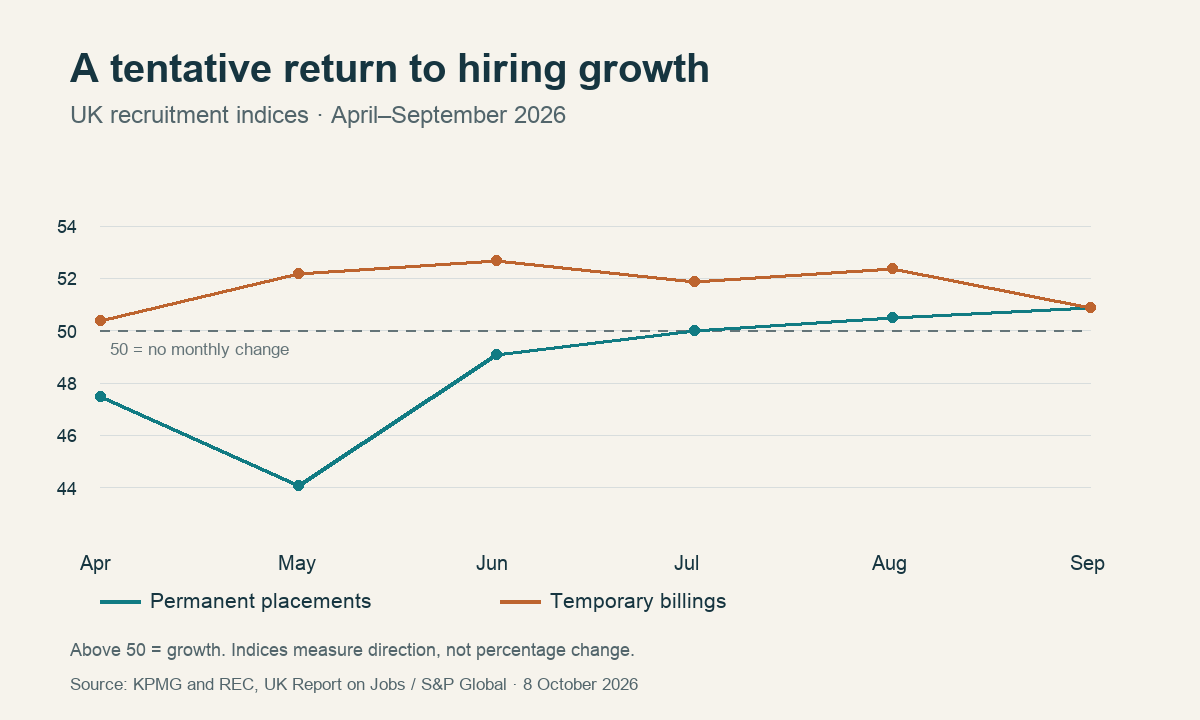
UK recruiters reported a second consecutive monthly rise in permanent placements in September, while temporary billings also increased, according to the latest KPMG and REC UK Report on Jobs.
The improvement remains modest. The permanent placements index rose from 50.5 in August to 50.9, its strongest reading in four years, while the temporary billings index eased from 52.4 to 50.9. Readings above 50 indicate growth from the previous month; they are not percentage growth rates.
Vacancy decline eases
The total vacancies index increased from 47.0 to 48.5, signalling the weakest decline in demand for workers since August 2024. Overall vacancies were still falling, despite the improvement.
Private-sector permanent vacancies increased for the first time in more than two years. Public-sector demand continued to decline. The private/public breakdown is not seasonally adjusted, unlike the headline indices.
“The permanent jobs market is revving its engine, with a second successive month of growth.”
Maxine Bligh, Interim Chief Executive, Recruitment and Employment Confederation
Recovery varies by region and role
Permanent placements increased in three of the four monitored English regions, led by the North, while the South continued to record a decline. Temporary billings rose in the North, Midlands and South but fell sharply in London.
IT and computing and engineering led the sectors reporting higher permanent vacancies. Retail and hotel and catering recorded the sharpest falls. Only blue-collar, IT and computing, and nursing, medical and care roles recorded growth in temporary vacancies.
Pay pressures soften
Permanent starting salaries continued to rise, but the pace of increase slowed for the first time in four months. Temporary pay growth also moderated. Recruiters reported that competition for skilled candidates was still supporting pay, while cost controls and improved candidate availability limited increases.
Candidate availability continued to grow, with recruiters citing redundancies and fewer opportunities. The overall rate of increase was the weakest in three years.
Jon Holt, Group Chief Executive and UK Senior Partner at KPMG, described the improvement as a fragile recovery and said businesses would look to the Budget for greater certainty.
Why it matters
For recruitment firms, the results offer a reason to revisit client hiring plans, but not to assume a broad rebound. Sector and regional differences remain important, and rising candidate availability does not remove shortages in specialist roles.
The findings build on REC research on improving employer confidence and its call for a longer-term workforce plan.
About the research: S&P Global compiled the KPMG and REC UK Report on Jobs from a panel of around 400 UK recruitment and employment consultancies. September responses were collected from 10–24 September 2026. The survey measures changes reported by consultancies, rather than a count of all UK jobs. The report was released on 8 October 2026.
Chart: Onrec, using figures supplied in the KPMG and REC UK Report on Jobs / S&P Global.