
Recent Robert Half research found that 67% of UK hiring managers say the need to screen for AI-generated application materials has increased the time it takes to hire. Almost half (48%) say AI-generated CVs and application materials are creating notable challenges for their organisation.
Perhaps most significantly, employers report seeing high volumes of generic applications alongside fabricated or embellished work histories, making it increasingly difficult to establish whether the experience presented on a CV accurately reflects the person behind it. But I don't believe the answer is to embark on a mission to identify every CV that has been written or improved using AI. Using generative AI to improve grammar, structure a CV or communicate experience more effectively is very different from using technology to invent qualifications, employment history or skills. With AI now embedded in everyday working life, attempting to draw a simple line between an "AI CV" and an “authentic CV” risk focusing on the wrong problem. The more important question for employers is much simpler: are the claims being made by this candidate true?
From detecting AI to verifying people
Recruitment has traditionally relied heavily on the CV as the starting point for establishing a candidate's suitability. But when sophisticated technology can produce an extremely polished and highly tailored application in seconds, the CV itself inevitably becomes less useful as evidence of capability. That doesn't mean employers should distrust candidates. It means recruitment processes need to evolve. Rather than investing increasing amounts of time trying to determine whether particular sentences were generated by AI, organisations should concentrate on the information that can be independently verified.
Identity, employment history, professional qualifications, education and other relevant credentials can all provide employers with greater confidence that the individual progressing through the recruitment process genuinely has the background they claim. And that verification may increasingly need to happen earlier. Background screening has traditionally been viewed as one of the final stages of recruitment – something undertaken once an organisation has identified its preferred candidate. The growth of AI-generated applications challenges that model.
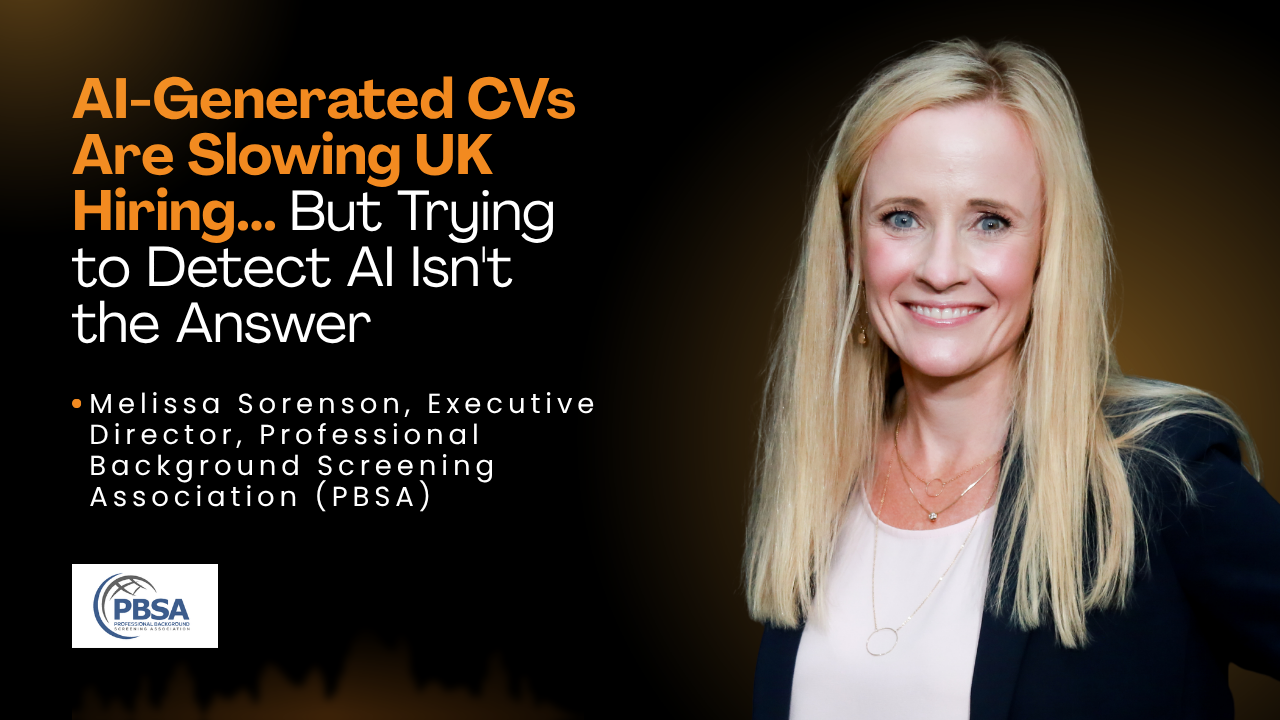
“Most candidates using AI will not be attempting to deceive an employer.”
Melissa Sorenson, Executive Director, Professional Background Screening Association (PBSA)
If employers are spending additional time interviewing and assessing candidates only to discover much later that fundamental elements of an application cannot be substantiated, there is an argument for moving appropriate verification further upstream.
Keeping technology in perspective
There is another danger here. If employers respond to generative AI simply by introducing more technology designed to detect generative AI, recruitment could get caught in a cycle of increasingly sophisticated generation and detection tools. That could add another layer of complexity without addressing the underlying issue. Technology undoubtedly has an important role to play in modern recruitment and screening, but it needs to be combined with appropriate human oversight and robust verification processes.
Employers also need to maintain a sense of proportionality. Most candidates using AI will not be attempting to deceive an employer. For many, it is simply another productivity tool. The distinction organisations need to make is therefore not between candidates who use AI and those who don't. It is between legitimate assistance and misrepresentation.
The latest findings should not prompt employers to become suspicious of every polished CV. They should prompt a broader conversation about how we establish trust when creating convincing application materials has never been easier.
AI may be changing what a CV looks like, but the fundamental requirement hasn't changed at all. Employers need to know that the person they are hiring is who they say they are, and that the qualifications, experience and credentials on which a hiring decision is based can be trusted.