
Adapted from a white paper by Colin Edge, Founder of The Recruitment Guru.
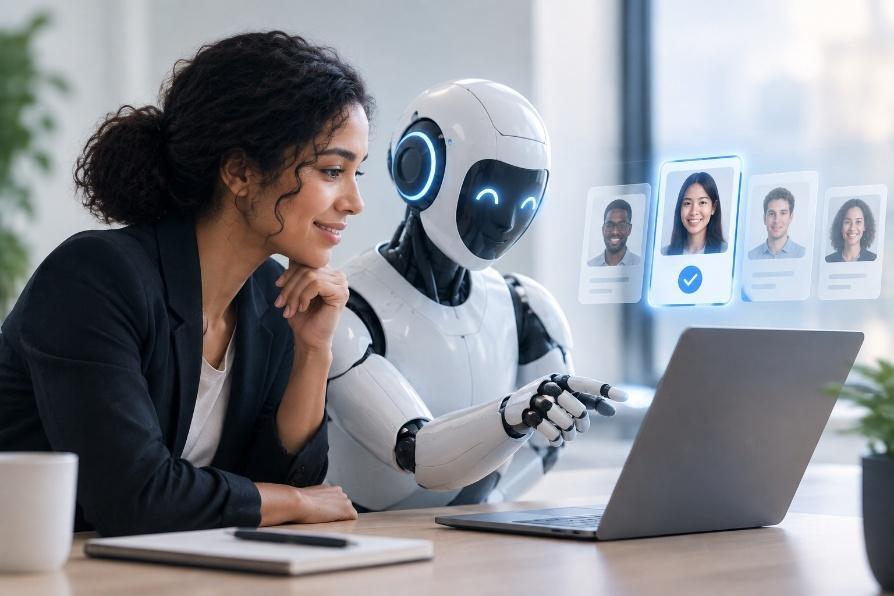
Artificial intelligence is reshaping recruitment, from automated sourcing to predictive analytics. It can reduce the administrative burden and help agencies work faster, but human judgement, emotional intelligence and relationships remain central to successful recruitment.
The Recruitment Guru argues that the opportunity is to combine technology with human expertise, particularly in skilled labour markets and client engagement.
Where AI can support recruitment
Agencies are using AI to parse CVs, match candidates to roles, automate sourcing, support candidate communication, identify workforce trends, manage documentation and schedule interviews. Agencies are using AI to parse CVs, match candidates to roles, automate sourcing, support candidate communication, identify workforce trends, manage documentation and schedule interviews. Modern talent acquisition software can bring several of these functions together, helping recruitment teams streamline sourcing and candidate management.
These tools can reduce repetitive work and allow consultants to spend more time on higher-value activity. The white paper highlights industrial, logistics, warehousing, hospitality and entry-level staffing as areas where automation can help agencies manage high application volumes.
Potential commercial benefits include quicker screening, lower administrative costs, faster candidate updates and access to insights from larger datasets. These benefits depend on how systems are designed and used; consistent automated criteria should not be mistaken for a guarantee that an AI system is free of bias.
Why relationships still matter
Matching skills is only part of recruitment. Understanding a candidate’s ambitions, interpreting a client’s priorities, managing counteroffers and negotiating a placement rely on context and experienced judgement.
For engineers, technicians, specialists, managers and executives, the quality of the human conversation can be as important as the efficiency of the process.
“AI is the engine. Humans are the differentiator. Together, they create a recruitment business that is faster, smarter, and more valuable.”
A hybrid model for agencies
The white paper proposes using AI for sourcing, screening support, scheduling, data analysis, documentation and workflow automation, while consultants lead client relationships, skilled candidate engagement, interviews, negotiation and strategic workforce advice.
For recruitment businesses, that means investing in consultants’ relationship skills as well as technology, positioning the agency as an adviser and using data to inform decisions without replacing judgement.
Edge’s central argument is that agencies should use automation to strengthen the people at the centre of their service, rather than allowing efficiency gains to weaken the relationships that distinguish them.
More information: The Recruitment Guru.