A customer dials in wanting an answer now, not a callback, not a place in a queue. The business wants the other side of the same coin: shorter waits, steady service, and a cost line that doesn't climb every time volume does. For decades the only levers were to add agents, extend shifts, or outsource the overflow.
AI voice agents add a lever that wasn't there before. But the way the question usually gets framed “can an AI voice agent replace a human agent?”, is the wrong one, and it leads teams into either overreach or paralysis. The question that actually helps is narrower: which customer-service calls should be handled by AI, and which genuinely need a human?
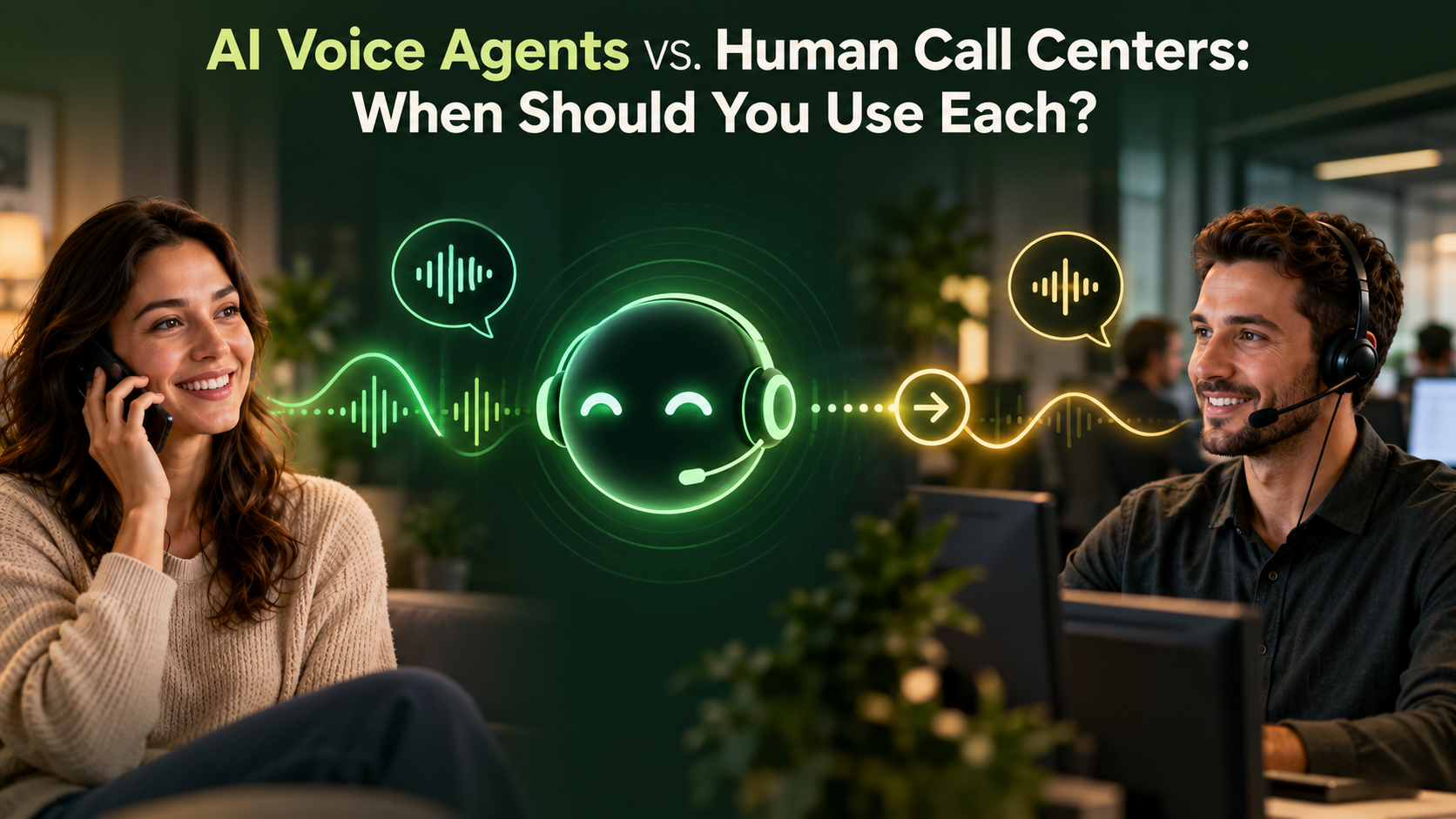
The short answer is that AI voice agents are very good at predictable, high-volume interactions and weak exactly where humans are strong. Most enterprises don't replace their call center; they end up with a hybrid, where AI absorbs volume and people handle the calls that need a person. This article lays out how to tell the two apart.
What Is an AI Voice Agent for Customer Service?
An AI voice agent is software that holds a spoken conversation with a customer and can act on what it hears. Unlike a recording or a rules-based menu, it understands a request however the caller phrases it, tracks what's already been said, and reaches into your systems to do something about it.
In practice, a capable voice agent can understand spoken requests, hold context across a multi-turn call, pull information from CRM and back-end systems, authenticate the caller, execute predefined actions such as booking or updating a record, hand off to a human with the context attached, log the interaction, and do all of it around the clock. It is closer to a first-line representative who never sleeps than to a smarter phone menu, which is the distinction most teams get wrong when they picture one.
AI Voice Agent vs Traditional IVR
The easiest way to see the difference is against the IVR system every enterprise already runs.
|
Traditional IVR |
AI Voice Agent |
|
Menu-driven |
Conversational |
|
"Press 1" workflows |
Natural-language requests |
|
Limited context |
Context-aware conversations |
|
Rigid, fixed paths |
Handles varied phrasing |
|
Mostly routing |
Can perform actions |
An IVR routes a call to a place; a voice agent tries to resolve it. That shift from directing traffic to completing tasks, is what makes the "when should we use one?" question worth asking at all, and it sits inside the broader discipline of designing AI agents for customer service as operating systems rather than features.
When Should You Use AI Voice Agents Instead of Human Call Centers?
The temptation is to reach for a benefits list. A decision framework is more useful, because the same technology is a clear win in one call type and a liability in another. Six conditions tend to signal that AI is the right handler.
1. When Call Volume Is High and Repetitive
The clearest case for a voice agent is the call your team has had ten thousand times. Order status, appointment confirmations, delivery updates, account-balance checks, password resets, policy-status queries, basic troubleshooting, payment reminders, high in volume, low in variation, and draining to staff precisely because they repeat.
Repetition matters for more than cost. The more predictable the conversation, the more precisely you can define the agent's workflow, its knowledge sources, the tools it may call, and its escalation rules. Predictability is what makes a voice agent reliable, and it's exactly what these calls have in abundance.
2. When Customers Need Support Outside Business Hours
A voice agent doesn't clock off. For after-hours and weekend coverage, a customer base spread across time zones, emergency intake, or overnight order updates, that changes the economics of availability, you're no longer choosing between an expensive night shift and simply not answering.
The design shifts too: an after-hours agent needs tighter escalation rules, because the human it would normally hand off to may not be online. Getting that handoff logic right is most of the work, which is why a round-the-clock deployment is worth treating as its own build.
3. When Customers Wait Too Long for Human Agents
Long queues are usually a distribution problem, not a headcount problem. A large share of the calls in the queue are simple, status checks, first-line troubleshooting, information requests, scheduling, and they're stuck alongside the calls that genuinely need a person.
A voice agent absorbs that simple layer. The point isn't to replace agents; it's to stop making a customer with a complex problem wait behind twenty people asking where their order is. Human agents spend their time on the calls that reward it, and the queue for those calls shortens because the easy traffic never enters it.
4. When Conversations Follow Predictable Workflows
A useful test is whether a call can be drawn as input → decision → action. When it can, a voice agent fits.
|
Consider: customer calls → verifies identity → asks about an order → agent checks the order system → gives the status. |
Every step is defined, every branch known, and the "decision" is really a lookup. Ideal automation candidate.
|
Now consider: customer calls → complex dispute → conflicting account information → emotional escalation → resolution needs judgment. |
Nothing there maps to a clean workflow: no single system of record to check, the right answer depends on weighing conflicting facts, and the caller's state matters as much as the facts. That call belongs with a human, not because the agent couldn't attempt it, but because attempting it well is the whole job.
5. When You Need Multilingual Voice Support
Language coverage is one of the hardest things to match with people. Staffing a specialised queue for every language a customer base speaks is expensive and brittle; coverage collapses the moment the one agent who speaks it is on leave.
A voice agent can detect the caller's language, hold the conversation in it, give the same answer it would in any other, and do so at every hour, removing much of the dependency on specialised language queues. For organisations serving several markets, that consistency is often the deciding factor. The specifics are worth their own read: multilingual customer support AI agents get into language detection, response parity, and where the model still needs guardrails.
6. When You Need to Scale Without Proportionally Increasing Headcount
This is the condition most often oversold, so state it carefully. A voice agent does not eliminate call-center cost. It changes the shape of the cost curve.
When volume grows, a seasonal spike, a new market, a launch, a traditional center scales by hiring, and cost rises in step with calls. A voice agent lets you absorb a chunk of that volume, relieve queue pressure, and take repetitive work off the team without adding a head for every increment of demand. The value isn't "no more agents." It's that human capacity gets pointed at the work that needs it, and volume growth stops translating one-to-one into headcount.
When Human Call Centers Are Still the Better Choice
A framework that only ever says "automate it" isn't a framework, it's a sales pitch. There are whole categories of call where routing to a human isn't a fallback, it's the correct design.
Complex or unstructured problems: Complicated technical issues, multi-step disputes, tangled account problems, anything needing investigation rather than a lookup. These have no defined workflow, exactly the property that makes automation work, and whose absence makes it fail.
Emotionally sensitive conversations: Complaints, bereavement, serious financial difficulty, an already-angry customer, any live escalation. Here the caller's emotional state is the thing being managed, and mishandling it costs you the relationship. Trying to automate it reads as exactly the corner-cutting customers resent most.
High-stakes decisions: Financial decisions, insurance disputes, medical-related interactions, legal matters, fraud investigations. When a wrong answer is costly, the accountability and judgment of a person are part of what the customer is paying for.
Situations requiring human judgment: The principle underneath the rest: a conversation being technically automatable is not a reason to automate it. Some calls are cheap to route to AI and expensive to get wrong, and knowing which is which is the actual skill.
AI Voice Agent vs Human Call Center: A Decision Matrix
Pulling the framework into one view, the split by interaction type is fairly consistent:
|
Customer interaction |
AI Voice Agent |
Human Agent |
|
Order tracking |
✓ |
|
|
Appointment scheduling |
✓ |
|
|
FAQs |
✓ |
|
|
Account information |
✓ |
|
|
Basic troubleshooting |
✓ |
|
|
Payment reminders |
✓ |
|
|
Complex disputes |
✓ |
|
|
Emotional complaints |
✓ |
|
|
Sensitive cases |
✓ |
|
|
Complex negotiations |
✓ |
|
|
Escalations |
✓ |
|
|
High-judgment situations |
✓ |
The pattern is hard to miss: the left column is predictable and transactional, the right column is variable and human. Which is precisely why the strongest deployments don't pick a column.
The Hybrid Model: AI Voice Agents + Human Agents
The enterprise answer isn't AI or people, it's a pipeline where AI is the first responder and humans are the specialists.
A typical flow looks like this:
➔ The customer calls and the AI voice agent answers immediately, no queue for the first touch.
➔ The agent detects intent from how the caller describes their problem.
➔ Simple or predictable requests are completed by the AI end to end: the status is given, the appointment booked, the reminder handled.
➔ Complex or sensitive requests are routed to a human, and critically, the AI passes the full conversation context along with the call, so the customer doesn't have to start over.
➔ The human resolves the issue, spending their time on the part that actually needs them.
That last handoff detail is what separates a good hybrid from a frustrating one. A transfer that drops the context and makes the customer repeat everything undoes the goodwill the fast pickup earned. Done well, the customer gets an instant answer when the answer is simple and a prepared human when it isn't.
7 Signs Your Business Is Ready for an AI Voice Agent
Before scoping a build, it's worth checking honestly against a readiness list. A business is usually ready when most of these are true:
➔ Call volumes are consistently high.
➔ A large share of those calls are repetitive.
➔ Customers frequently call outside business hours.
➔ Wait times are visibly hurting the customer experience.
➔ Human agents spend significant time on low-complexity tasks.
➔ Customer and operational data is structured enough to be retrieved reliably.
➔ Escalation rules for human handoff are clear, or can be defined.
The last two matter more than they look. A voice agent is only as good as the data it can retrieve and the escalation logic that catches what it shouldn't handle. If those two aren't in place, that's the work to do first, not a reason the rest doesn't apply.
What to Evaluate Before Deploying an AI Voice Agent
Readiness is about your call mix; deployment is about your stack. Nine things determine whether a voice agent works in production rather than in a demo.
Existing contact center infrastructure: How the agent slots into your current telephony and routing, rather than replacing it wholesale.
CRM and back-end integrations: The agent is only useful if it can read and write to the systems where customer data actually lives.
Knowledge base quality: The agent's answers are downstream of your knowledge base. If it's stale or contradictory, the agent inherits that.
Authentication and customer verification: How callers are identified securely before the agent acts on their account.
Human escalation: The routing rules and context handoff that decide when and how a call reaches a person, the make-or-break detail from the hybrid model.
Voice quality and latency: A natural-sounding voice and low response lag are not cosmetic; delay and stiltedness are what make callers ask for a human.
Security and privacy: Handling of sensitive customer data, and compliance with whatever regime governs your industry and region.
Monitoring and evaluation: How you'll measure containment, accuracy, and escalation quality once it's live, and catch drift.
Cost per interaction: The real unit economics at your volume, including model and infrastructure cost, not the sticker price of a prototype.
That list is also, not coincidentally, a fair description of why enterprise voice agents take real engineering rather than a wrapper around a speech API.
Should You Replace Your Call Center With an AI Voice Agent?
A simple yes or no would be dishonest. The useful answer is a rule for sorting.
Use AI voice agents where the interaction is predictable, high-volume, needed around the clock, and backed by reliable business data. Keep humans where the interaction needs judgment, empathy, investigation, negotiation, or escalation. Then connect the two with a hybrid architecture, so a customer is met by AI when AI is the right responder and by a prepared human when it isn't.
Framed that way, "replace the call center" stops being the question. The question becomes how to route each call to the handler that resolves it best.
Building an AI Voice Agent for Customer Service
One thing the evaluation list makes clear: an enterprise voice agent is not a voice interface with a chatbot behind it. Getting containment and trust right in production means assembling a stack.
That stack typically includes the model layer, speech-to-text and text-to-speech, a customer-service knowledge base the agent retrieves from, CRM integration, connections to the APIs and business tools that let it act, authentication, workflow orchestration for multi-step tasks, guardrails to keep it inside its remit, human handoff with context, and monitoring and evaluation to keep it honest over time.
Wiring those together, especially the integrations into CRM, ERP, payment, or ticketing systems that let the agent do more than talk, is where most of the engineering lives. This is what AI voice agent development services exist to do, and where custom AI agent development services matter most when the agent has to plug into systems never designed to be called by one.
Final Takeaway
AI voice agents aren't automatically better than human call centers. They're better suited to certain kinds of customer interaction, and worse suited to others in ways that don't improve with a better model.
The strongest enterprise pattern is simple to state: AI handles volume, humans handle complexity. Repetitive calls, after-hours calls, high-volume predictable workflows, and multilingual support go to AI. Complex problems, emotionally sensitive conversations, and escalations stay with people. A hybrid pipeline connects the two so neither is doing the other's job.
So the exercise worth doing isn't deciding whether to replace your call center. It's looking honestly at your actual call mix, what share is predictable and transactional, what share needs a person, and routing accordingly. The answer is already sitting in your call logs.