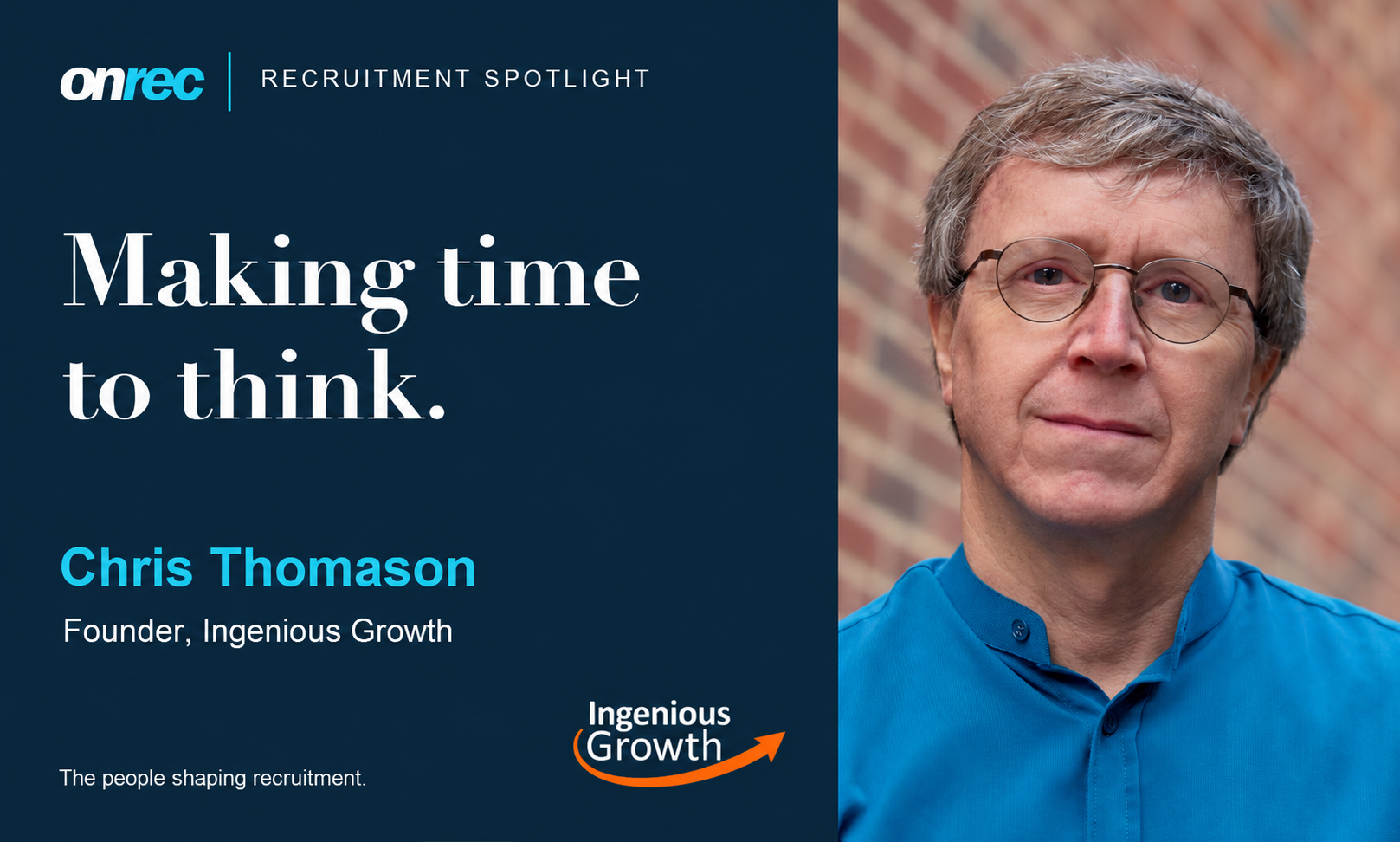
What happens when organisations become so busy that people have little opportunity to think? In this Recruitment Spotlight, Chris Thomason, founder of Ingenious Growth and creator of Transformational Thinking, discusses the conditions that help people question assumptions, develop better options and use AI with judgement.
Key takeaways
- Workplaces should make room for reflective thinking as well as the fast responses needed for day-to-day work.
- AI makes critical and creative thinking more important, because people still need to frame questions and judge the answers.
- Leaders can create better conditions by protecting focused time, separating routine updates from deeper questions and rewarding value rather than visible busyness.
“Why do we recruit people for their brains, then fill their diaries so they barely have time to use them?”
Chris Thomason, Founder, Ingenious Growth
The conditions for good thinking
Why has the workplace become somewhere people struggle to think clearly?
Our survey asked 3,935 UK adults where they felt their best thinking happened – and only 2.5% selected work or volunteering. That’s a finding about people’s perceptions, rather than a direct measure of employees’ performance, but it raises an important question around whether workplaces provide the conditions for good thinking.
Many working days are organised around the needs of others, such as meetings, messages, immediate questions and other competing demands. These may all be necessary, but they leave little room to step back and challenge the conventional way of thinking about work issues.
I separate reactive thinking, which helps us respond in the moment, from reflective thinking, which allows us to explore something more deeply. Organisations need both, yet we often end up arranging the whole day around the first. Why do we recruit people for their brains, then fill their diaries so they barely have time to use them?
Have workplace cultures unintentionally discouraged deeper thinking?
Yes, but unintentionally. People learn what their organisation rewards and what the culture values. If instant replies and a packed calendar signal commitment, employees can feel uncomfortable protecting time to think – even when that thinking could prevent a costly mistake or reveal a valuable opportunity.
While thinking is invisible, busyness is easy to see. This can create what I call cognitive debt, where assumptions, shortcuts and unresolved questions accumulate because nobody has time to revisit them. Eventually, people spend more effort working around problems that better thinking might have removed.
A full diary tells you how someone’s time is occupied, but it doesn’t tell you how much value they are creating. Leaders need to recognise the value someone creates, rather than simply how occupied they appear.
AI and human judgement
Is critical and creative thinking becoming more important as AI becomes embedded in the workplace?
Absolutely. My concern is that we treat AI adoption mainly as a technology challenge, when it’s also a thinking challenge.
Employees need to frame worthwhile questions, examine the answers they receive, recognise missing context and decide what should happen next. Creative thinking also helps them develop alternatives beyond the first plausible answer.
For recruitment and HR, that means asking whether AI is helping us achieve a better outcome, or simply helping us process an existing approach more quickly. It sometimes comes down to short-term gains being perceived as more beneficial than long-term, enduring value.
Transformational Thinking focuses on the upstream work that questions the problem and develops stronger options before making a decision. Because more options don’t automatically mean better decisions, stronger, meaningfully different options can give human judgement more to work with. AI can always produce an answer – but people still have to decide whether it answers the right question.
What role should employers and HR leaders play?
Employers should treat thinking as part of the work they are paying people to do. That means providing time, clear priorities, useful thinking methods and permission to question established approaches.
I describe an organisation’s Thinking Layer as the way people identify issues, develop options, challenge assumptions and exercise judgement across the business. It operates everywhere, delivers every element of growth, yet nobody actually owns it – which means it’s effectively neglected.
HR is well placed to bring that thinking layer into view through job design, management expectations, development and performance conversations. From there, operational leaders need to make it work in practice.
Flexible work, practical change and better meetings
Has hybrid and remote working helped people think more clearly?
It can do either. Flexibility gives people the opportunity to find a setting and rhythm that suit particular tasks. But a remote day filled with video calls and notifications can be just as fragmented as a day in the office.
Home isn’t quiet for everyone, and an office can provide valuable space, support and conversation. The important question is what kind of work someone needs to do and which conditions will help them do it well. Teams should make deliberate arrangements for collaboration, focused work and reflection, rather than assuming that a particular location automatically provides them.
People often do their best thinking when performing some light, personal activity like showering, exercising, driving or walking the dog. Hybrid or remote working offers the flexibility to take 30 minutes to walk the dog and take a tricky issue with you too – which isn’t possible in the office.
What can organisations learn from businesses that value thinking time?
3M and Google provide well-established examples of “15% and 20% cultures” respectively. This encourages employees to devote a portion of their working time to developing ideas and exploring projects, while coordinating with managers to fulfil their responsibilities. Both companies connect this freedom with innovation.
Amazon offers a different example through its documented use of narrative memos and silent reading at the start of meetings. This creates time for people to understand and consider a proposal before discussing it.
These are useful practices to learn from, but aren’t evidence that every part of either company has ideal thinking conditions. A smaller employer doesn’t need to copy them directly; it can apply the principle to build thinking into how work happens and support it with management behaviour.
What simple changes can employers introduce without affecting productivity?
Start by recovering time from existing activity and applying it to a worthwhile issue. Send out the key question before a meeting, so people can consider it during their working day. Ask them to bring an alternative, an assumption worth testing or a possible consequence – not just an immediate opinion.
Separate routine updates from issues that need deeper exploration and, where practical, share updates asynchronously and use the meeting to consider people’s pre-prepared contributions.
Try a short, protected thinking period around a specific question like “What could we change to give everyone in this team one hour back each week?” Gather the ideas, then choose one small experiment and assess whether it saves time or improves the work. Big benefits can accrue from small steps.
About Chris Thomason: Chris Thomason is founder of Ingenious Growth Ltd and creator of Transformational Thinking.